Charging time is one of the main operational differences between lithium-ion and lead-acid industrial batteries. A conventional flooded lead-acid forklift battery commonly requires about eight hours for a full charge, while a lithium-ion battery can charge in approximately one to two hours when paired with a compatible high-output charger. Some lithium systems can charge faster, but actual results depend on battery capacity, charger power, starting state of charge, temperature and BMS limits.
For industrial buyers, the relevant question is not only how long a battery takes to reach 100%. You also need to consider cooling time, equalization, available charging breaks, charger infrastructure and how much energy must be restored before the equipment returns to service.
Lithium vs Lead-Acid Charging Time at a Glance
| Charging Factor | Lithium-Ion Industrial Battery | Conventional Flooded Lead-Acid Battery |
|---|
| Typical full-charge time | Approximately 1–2 hours with a compatible high-output charger | Approximately 8 hours under conventional charging |
| Cooling period after charging | No separate lead-acid cooling period | A cooling period is commonly included before reuse |
| Total conventional turnaround | Primarily determined by charging time | Charging and cooling can occupy approximately 16 hours in conventional battery rotation |
| Partial charging | Commonly used during breaks and shift changes | Possible with an approved opportunity-charging system, but requires specific charging management |
| Battery removal | Usually remains installed in the vehicle | Frequently removed in multi-shift battery-change systems |
| Equalization | Not normally required | Periodic equalization is commonly required for flooded batteries |
| Charger control | BMS communicates charging limits to the charger | Controlled by the charger and battery charging profile |
| Charging behavior | Can receive frequent partial charges | Conventional practice generally uses scheduled full charging |
| Effect of charger size | Larger compatible charger can reduce charging time | Charger output and approved charge rate also determine duration |
| Site power requirement | Fast charging can require substantial electrical capacity | Conventional chargers spread charging over a longer period |
These are general operating patterns rather than fixed values. Specific lithium and lead-acid products can use different charging technologies and profiles.
Why Charging-Time Comparisons Vary
Published figures such as “one-hour charging” or “eight-hour charging” do not apply to every industrial battery.
Charging time depends on:
A small pallet-truck battery connected to a low-output onboard charger can take several hours to charge. A larger forklift battery connected to a high-power offboard charger can recover substantial energy in a shorter period.
For example, one Hyster compact pallet stacker with a 60Ah lithium battery and 24V/15A onboard charger is specified for a four-hour full charge. By comparison, selected high-capacity Hyster lithium forklifts with high-power offboard charging can reach full charge in less than 90 minutes.
The battery chemistry alone does not determine charging time. The battery, charger and electrical infrastructure must be considered as one system.
How Long Does a Lead-Acid Industrial Battery Take to Charge?
A conventional flooded lead-acid forklift battery typically requires approximately eight hours for a full charge. In battery-change operations, it can then require additional cooling time before returning to service. Toyota publishes approximately eight hours as a typical lead-acid charging duration, while Hyster uses an example of roughly 16 hours for combined charging and cooling.
A traditional multi-shift cycle can therefore look like this:
The discharged battery is removed from the forklift.
A charged battery is installed.
The discharged battery is connected to a charger.
The battery charges for approximately eight hours.
The battery cools before returning to service.
Periodic watering, inspection and equalization are completed as required.
This operating method often requires more than one battery per forklift because the truck must continue working while another battery is charging or cooling.
Why Lead-Acid Charging Takes Longer
Lead-acid charging normally progresses through defined charging stages. As the battery approaches full charge, the charger reduces current to manage the electrochemical process and complete charging without excessive temperature or gassing.
The charging period also needs to account for:
Reducing the charging duration without using an approved battery-and-charger system can leave the battery undercharged, increase temperature or affect service life.
Equalization Adds Scheduled Charging Time
Flooded lead-acid batteries commonly require periodic equalization charging. Equalization applies a controlled overcharge to help address charge imbalance and sulfate accumulation between cells.
Equalization is not normally completed after every working cycle, but it must be included in the charging and maintenance schedule. Toyota notes that failure to equalize lead-acid batteries can allow sulfation to reduce capacity and runtime.
The frequency and duration should follow the battery and charger manufacturers’ instructions.
How Long Does an Industrial Lithium Battery Take to Charge?
A lithium-ion forklift battery commonly takes approximately one to two hours to reach full charge when paired with a suitable high-output charger. Toyota lists one-to-two-hour charging as a general lithium-ion figure and specifies approximately two hours for its current 24V, 36V and 48V 8/50 lithium battery range.
Charging can be shorter for specific systems. Toyota’s 5/35 battery platform can charge in as little as one hour with a dual-cable fast charger, while selected Hyster lithium forklift systems can reach full charge in less than one hour or less than 90 minutes, depending on the truck and charging arrangement.
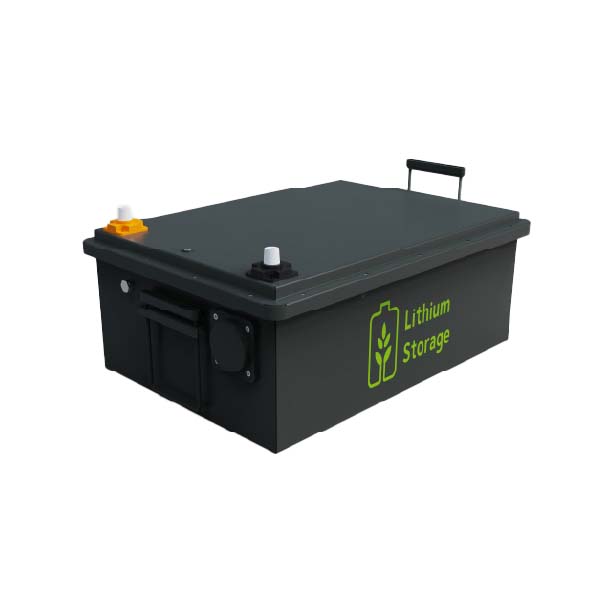
LITHIUM STORAGE states that its forklift battery systems can reach approximately 80% state of charge within one hour. Its product range includes 24V, 36V, 48V and 80V lithium batteries together with corresponding charger options.
These figures should not be treated as a guarantee for every battery. The supplier must calculate the expected charging time for the exact capacity and charger.
Full Charging and Opportunity Charging Are Different
A full-charge time describes how long it takes to bring the battery from a defined low state of charge to approximately 100%.
Opportunity charging describes shorter charging sessions completed during periods when the equipment is already idle.
Typical charging opportunities include:
Meal breaks
Rest breaks
Shift changes
Loading delays
Production stops
Cleaning periods
Overnight parking
A lithium battery does not always need to reach 100% before the forklift returns to work. A warehouse can instead restore only the energy required to operate until the next charging opportunity.
Toyota explains that opportunity charging allows the battery to remain installed over multiple shifts while receiving energy during breaks. The same method can be applied to certain lead-acid systems, but lithium batteries are more commonly configured for frequent partial charging.
How Much Energy Can Be Added During a Break?
The amount of energy restored depends primarily on charger power and the battery’s approved charging limit.
A simplified calculation is:
Energy added in kWh = Charger output in kW × Charging time in hours × Charging efficiency
For example, using an assumed 90% charging efficiency:
| Charger Output | Charging Period | Approximate Energy Added |
|---|
| 6kW | 30 minutes | 2.7kWh |
| 10kW | 30 minutes | 4.5kWh |
| 15kW | 30 minutes | 6.75kWh |
| 20kW | 30 minutes | 9kWh |
| 30kW | 30 minutes | 13.5kWh |
These are calculation examples, not specifications for a particular battery.
To decide whether a 30-minute break is enough, compare the energy restored with the energy the forklift consumes between charging periods.
For example, when a forklift consumes 6kWh between the morning break and lunch, a charging session that reliably restores at least 6kWh can maintain the daily energy balance. A margin should be included for changing workloads, charger losses and temperature-related current limits.
Calculating Approximate Full-Charge Time
For industrial batteries, charging time can be estimated using energy rather than amp-hours:
Charging time = Energy to be restored ÷ Effective charger output
Consider a 51.2V 456Ah lithium battery:
Nominal energy = 51.2 × 456 ÷ 1,000 = 23.35kWh
Assume the battery begins charging at 20% state of charge and the target is 100%. Approximately 80% of the nominal energy must be restored:
23.35 × 80% = 18.68kWh
With a 15kW charger and an assumed 90% charging efficiency:
18.68 ÷ (15 × 0.90) = approximately 1.38 hours
Actual charging will usually take longer because the BMS can reduce current according to battery temperature, cell voltage and state of charge.
The final charging proposal should therefore state:
Time from 20% to 80%
Time from 20% to 100%
Energy restored during a 15-minute break
Energy restored during a 30-minute break
Maximum battery charging current
Charger output
Conditions under which current is reduced
Charger Output Can Change the Result Significantly
Lithium charging is not always fast. A battery connected to a low-output onboard charger can require a full working shift or overnight period to charge.
Hyster provides an example in which an integrated lithium forklift charges from lift lockout to 100% in at least:
2 hours and 35 minutes with a 6kW, 240V onboard charging connection
11 hours and 5 minutes with a 1.4kW, 120V connection
The same forklift can still use a higher-power offboard charger when a shorter charging period is required.
This demonstrates an important distinction:
Battery charging capability indicates how much charging current the battery can accept.
Charger output indicates how much power the charger can supply.
Site electrical capacity determines whether that charger can operate at its rated output.
The actual charging rate is limited by the lowest of these three factors.
Why Lithium Batteries Do Not Require Lead-Acid Cooling Time
Conventional lead-acid battery rotation often includes cooling after charging. The battery temperature rises during charging, particularly toward the end of the cycle and during equalization.
Lithium battery charging is actively controlled by the BMS. The system monitors temperature, cell voltage and charging current, and it can reduce or stop charging when operating limits are reached.
Lithium batteries still produce heat and have defined charging-temperature limits. However, they do not use the separate post-charge cooling stage associated with conventional flooded lead-acid battery rotation. Toyota identifies the absence of a charging cool-down period as one of the day-to-day operating differences when moving to lithium-ion forklift batteries.
Removing this cooling stage changes the total turnaround time even when the charging-time difference alone appears smaller.
Charging Time in Single-Shift Operations
In a single-shift facility, the equipment can have eight or more hours available for overnight charging.
In this operating pattern:
A conventional lead-acid battery can complete a scheduled full charge.
A lithium battery can charge over a shorter period and remain connected or disconnected according to the approved operating procedure.
Opportunity charging might not be operationally necessary.
Charger acquisition cost and existing infrastructure can influence the purchasing decision.
The fact that lithium can charge in one or two hours does not always create additional productive time when the forklift is already parked overnight.
For a single-shift application, buyers should compare:
Existing overnight downtime
Current charger condition
Maintenance requirements
Expected battery life
Electricity consumption
Planned fleet replacement period
Charging Time in Two- and Three-Shift Operations
Charging duration has a more direct effect when forklifts operate across two or three shifts.
A conventional lead-acid system can use spare batteries so that one battery powers the truck while another charges and cools. A lithium system can use opportunity charging to keep the battery installed in the truck across shifts.
The lithium charging plan must show that:
Starting battery energy + energy added during the day ≥ total daily energy consumption + required reserve
For example:
| Daily Energy Item | Energy |
|---|
| Starting usable energy | 25kWh |
| Morning-break charge | 5kWh |
| Lunch charge | 8kWh |
| Shift-change charge | 6kWh |
| Second-shift break charge | 5kWh |
| Total available energy | 49kWh |
| Daily forklift consumption | 43kWh |
| Remaining calculated reserve | 6kWh |
This type of energy balance is more useful than asking only whether the battery can charge fully in one hour.
Opportunity Charging with Lead-Acid Batteries
Opportunity charging is not limited exclusively to lithium-ion chemistry. Certain lead-acid technologies and charger systems are designed for fast or opportunity charging.
EnerSys, for example, offers TPPL lead-acid battery systems configured for partial and opportunity charging. These are different from conventional flooded lead-acid batteries following a traditional full-charge-and-cool rotation.
When comparing charging times, identify the exact lead-acid technology:
Flooded lead-acid
Tubular flooded lead-acid
Valve-regulated lead-acid
Gel
Thin plate pure lead
Fast-charge lead-acid system
A general statement such as “all lead-acid batteries require 16 hours” does not describe every industrial lead-acid product. The 16-hour figure refers primarily to the conventional cycle that combines approximately eight hours of charging with a cooling period.
Charging Temperature Can Extend the Process
Both battery types have approved charging-temperature ranges.
For lithium batteries, the BMS can reduce charging current or prevent charging when the battery is too cold or too hot. Toyota’s 8/50 lithium battery specification lists a standard charging range of 17°C to 45°C, with reduced-rate charging available outside part of that range.
Cold-storage lithium batteries can require:
Lead-acid battery charging is also affected by temperature, electrolyte condition and battery age.
When requesting a charging-time calculation, state:
Minimum operating temperature
Maximum operating temperature
Battery temperature when charging begins
Whether charging occurs inside or outside cold storage
Whether the battery includes heating
Whether reduced charging current applies
A supplier’s room-temperature charging figure might not represent a freezer or outdoor application.
The Role of the Battery Management System
An industrial lithium battery commonly uses a BMS to coordinate charging with the charger.
The BMS monitors:
Individual cell voltage
Battery voltage
Charging current
Battery temperature
State of charge
Cell balance
Contactor status
Fault conditions
The BMS communicates the allowable charging current to the charger. Current can be reduced when:
A cell approaches its maximum voltage
Battery temperature is outside the preferred range
The battery is approaching full charge
Cell balancing is required
A communication or sensor fault occurs
This is why dividing battery Ah by charger amperage provides only an estimate. Charging current does not necessarily remain constant throughout the entire cycle.
LITHIUM STORAGE’s forklift battery range includes charger communication commissioning and matched lithium charger options for different voltage platforms.
Charging Connectors and Communication Must Match
A charger with the correct voltage is not automatically compatible with the battery.
Buyers should confirm:
Charger DC output range
Maximum output current
Battery maximum charging current
Battery chemistry
CAN communication protocol
Connector manufacturer and model
Connector current rating
Connector pinout
Cable cross-section
Charge interlock
Emergency disconnect
Charger software configuration
Toyota states that lithium forklift batteries require chargers rated for the battery chemistry and voltage. Its current lithium systems also integrate charger communication with the onboard battery management system.
An incompatible charger can create charging errors, incorrect current limits or failure to begin charging.
Site Power Can Become the Limiting Factor
Shorter charging time requires greater charger power.
For example, restoring approximately 20kWh requires at least:
| Target Charging Time | Approximate Charger Power Before Losses |
|---|
| 4 hours | 5kW |
| 2 hours | 10kW |
| 1 hour | 20kW |
| 30 minutes | 40kW |
A high-output charger can require:
Three-phase AC power
New electrical circuits
Larger breakers
Panel upgrades
Transformer-capacity review
Demand-charge management
Additional ventilation around charging equipment
Cable and connector upgrades
A warehouse can purchase a battery capable of rapid charging but still experience long charging times when the available electrical supply limits charger output.
Before ordering, provide the battery supplier with:
Centralized vs Distributed Charging
Lead-acid fleets often use centralized battery rooms because batteries are removed for charging, cooling and maintenance.
Lithium fleets commonly use distributed charging points closer to operating areas. This allows operators to connect forklifts during existing breaks without travelling to a central battery room.
Charger placement affects the real charging time available. A 30-minute break does not provide 30 minutes of charging when the operator spends ten minutes driving to and from a distant charger.
When planning charger locations, consider:
Distance from work zones
Aisle and pedestrian safety
Cable management
Emergency access
Electrical distribution
Number of forklifts per charger
Shift-break congestion
Protection from impact and moisture
Hyster recommends placing chargers where operators can access them conveniently during lunch and other periods when forklifts are not in use.
How Charging Time Affects the Number of Batteries Required
A conventional multi-shift lead-acid operation can require more than one battery per forklift because each pack spends a large part of the day charging or cooling.
A lithium battery can remain installed when opportunity charging restores enough energy throughout the day. Hyster states that rapid charging can support a one-to-one battery-to-forklift ratio in suitable applications.
This arrangement is not determined by charging time alone. It also requires:
Sufficient battery capacity
A charger with sufficient output
Reliable charging breaks
Correct charger placement
Operator compliance
A daily energy reserve
 EN
EN
 fr
fr  de
de  it
it  ru
ru  es
es  pt
pt  tr
tr  jp
jp  ar
ar  th
th 

.jpg "How Long Does a Forklift Battery Last?")
 No.9 East Mozhou Road, Jiangning District, 211111, Nanjing City, China