Buying a lithium-ion forklift battery requires more than comparing voltage and amp-hour capacity. A battery can have the correct electrical rating and still be unsuitable because of its size, weight, discharge capability, connector, charging protocol, operating temperature, or communication system.
The right Lithium Ion Forklift Battery must work as part of a complete system that includes the forklift, battery management system, charger, cables, connectors, counterweight, and daily operating schedule. Hyster emphasizes this system-level approach because mismatched software, charging equipment, or communication can cause faults and charging errors.
This guide explains the specifications that purchasing managers, fleet operators, forklift dealers, and warehouse engineers should check before ordering.
Essential Forklift Battery Specifications
| Specification | Why It Matters | Information to Confirm |
|---|
| Rated voltage | Determines electrical compatibility | 24V, 36V, 48V, 80V or another specified platform |
| Capacity | Influences available operating energy | Ah rating and nominal kWh |
| Discharge current | Determines whether the battery can support traction and lifting demand | Continuous and peak discharge current |
| Battery dimensions | Determines whether the pack fits the compartment | Length, width, height and cable outlet position |
| Battery weight | Affects counterbalance and forklift stability | Minimum and maximum permitted weight |
| Chemistry | Influences thermal behavior, service life and charging characteristics | LFP, NMC or another chemistry |
| BMS functions | Protects and controls the battery | Cell monitoring, temperature control, contactors and fault logging |
| Communication | Enables integration with the truck and charger | CAN protocol, pinout and software compatibility |
| Charging specification | Determines charging time and infrastructure | Charger voltage, current, AC input and communication |
| Connector | Affects physical and electrical connection | Brand, model, current rating and orientation |
| Temperature range | Determines suitability for cold or hot environments | Charging, discharging and storage limits |
| IP rating | Indicates protection against dust and moisture | IP54, IP65 or application-specific rating |
| Cycle-life conditions | Helps estimate expected service life | Test depth of discharge, temperature and end-of-life definition |
| Warranty | Defines supplier responsibility | Years, operating hours, cycles and exclusions |
| Compliance documents | Supports transport and market acceptance | UN38.3, MSDS and applicable regional documents |
1. Rated Voltage Comes First
The battery voltage must match the electrical system specified by the forklift manufacturer.
Common forklift voltage classes include:
24V for pallet trucks and compact stackers
36V for some reach trucks and existing North American fleets
48V for many warehouse and electric counterbalance forklifts
80V for more demanding electric counterbalance applications
Lithium iron phosphate batteries are often labeled with nominal voltages such as 25.6V, 38.4V, 51.2V and 83.2V while being sold within the traditional 24V, 36V, 48V and 80V forklift classes.
Do not select a higher-voltage battery simply to obtain more power. The truck’s motor controller, traction motor, hydraulic pump, contactors, wiring, instruments and charger are designed for a defined voltage range.
Before purchasing, check:
A 48V truck should not receive an 80V battery as a direct replacement. Any voltage conversion requires a complete engineering review rather than a battery-only change.
2. Capacity Must Match the Daily Duty Cycle
Battery capacity is normally stated in amp-hours, but Ah should not be evaluated independently from voltage.
Nominal battery energy can be calculated as:
Nominal energy in kWh = nominal voltage × capacity in Ah ÷ 1,000
For example:
51.2V × 456Ah = 23.35kWh
83.2V × 314Ah = 26.12kWh
This calculation makes it easier to compare batteries across different voltage platforms. However, nominal energy does not equal actual runtime because the forklift’s consumption changes according to:
Capacity should be selected from measured or reasonably estimated energy consumption. An oversized battery increases cost and can create dimensional or weight problems. An undersized battery causes frequent charging interruptions and insufficient shift coverage.
Questions to Ask Before Selecting Capacity
How many hours does the forklift operate per shift?
How many shifts run each day?
What is the average loaded travel distance?
How often does the forklift lift?
What is the typical lift height?
Are clamps, rotators or other attachments used?
How much charging time is available during breaks?
Is a reserve state of charge required at the end of the shift?
Toyota lists capacity, battery-compartment width, weight, charging time and operational temperature as separate specifications, showing that capacity is only one part of battery selection.
3. Continuous and Peak Discharge Current
Two batteries with the same voltage and Ah rating do not necessarily deliver the same power.
Purchasers should request:
Maximum continuous discharge current
Short-duration peak discharge current
Duration allowed at peak current
BMS current-limiting conditions
Low-state-of-charge power limits
High- and low-temperature derating
The continuous current rating determines whether the battery can support normal driving and hydraulic operation without overheating or triggering protection.
Peak current is important during:
Do not accept a specification that only lists capacity. The supplier should confirm that the battery’s current capability matches the forklift controller and actual application.
4. Battery Dimensions and Compartment Fit
Forklift batteries are not standardized only by voltage. Trucks using the same voltage can have different battery compartments, cable positions and restraint systems.
Measure:
Compartment length
Compartment width
Compartment height
Maximum allowable battery height
Available clearance above the battery
Cable outlet location
Connector mounting position
Battery removal direction
Lifting-eye position
Fork-pocket requirements
A battery that is slightly too tall can interfere with the seat, cover or locking system. A cable outlet in the wrong position can create bending, abrasion or connection problems.
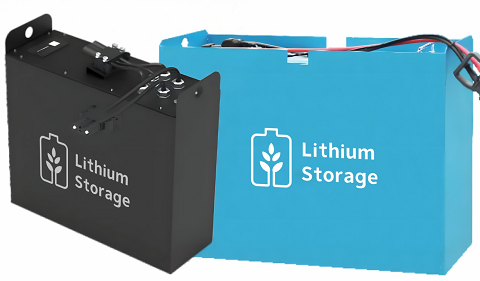
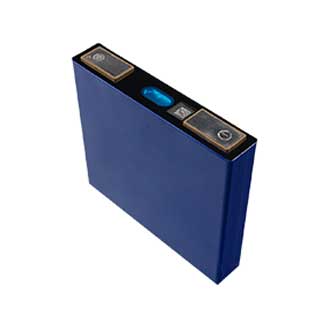
Lithium Storage uses separate inner-pack and outer-box configurations to adapt battery dimensions and additional weight to different forklift models. Its 51.2V 456Ah example also lists connector adaptation, customized enclosure arrangements and forklift-specific configuration rather than presenting the battery as a universal replacement.
5. Battery Weight and Counterbalance Requirements
Battery weight is a critical forklift specification, not merely a shipping detail.
In many electric forklifts, the original lead-acid battery contributes to the truck’s counterweight. Replacing it with a lighter lithium battery without compensating for the weight difference can affect:
Confirm:
Existing battery weight
Forklift minimum battery weight
Forklift maximum battery weight
Required center of gravity
Whether additional ballast is needed
Whether ballast is integrated into the battery enclosure
Toyota identifies built-in counterweight and adjustable spacers as battery features used to meet truck weight and fit requirements.
Do not assume that lighter is always better. For a forklift traction battery, the correct weight is more important than minimum weight.
6. Battery Chemistry
The supplier should clearly identify the battery chemistry.
Lithium iron phosphate, commonly abbreviated as LFP or LiFePO4, is widely used in material-handling batteries. Hyster highlights LFP characteristics such as temperature tolerance, cycle capability and suitability for multi-shift charging applications.
Ask the supplier to specify:
The phrase “lithium-ion battery” alone is not sufficiently detailed because lithium-ion includes several chemistries with different voltage, thermal and charging characteristics.
7. Battery Management System Functions
The BMS is responsible for monitoring and controlling the battery pack.
At minimum, it should monitor:
It should provide protection against conditions such as:
Hyster describes a BMS that continuously monitors cell voltage, module temperature and overall battery current. It also communicates with the charger to adjust charging current and can open the charge contactor when operating limits are approached.
Purchasers should ask what happens when communication is lost, a sensor fails or the battery reaches a protection threshold. A list of protection functions is less useful without an explanation of how the system responds.
8. Forklift and Charger Communication
Correct voltage does not guarantee compatibility. Modern forklift batteries often communicate with both the truck and charger through CAN bus.
Communication can control or transmit:
A battery with the wrong CAN protocol can produce inaccurate state-of-charge information, fault codes, reduced power or failure to operate.
Before ordering, confirm:
Toyota states that its BMS communicates critical information to compatible forklifts and chargers. Lithium Storage’s 51.2V 456Ah product also lists vehicle CAN support and charger communication commissioning.
Ask the supplier whether compatibility has been verified for the exact forklift model, not merely the forklift brand.
9. Charger Voltage, Current and Charging Time
The charger must be selected together with the battery.
Important charger specifications include:
DC output voltage
Maximum DC output current
AC input voltage
Single- or three-phase input
Input power requirement
Connector type
CAN protocol
Charging profile
Charging efficiency
Environmental protection
Installation requirements
Charging time can be estimated from battery capacity and charger output, but actual charging speed is affected by BMS limits, battery temperature, state of charge and the charging curve.
A 456Ah battery paired with a 150A charger will charge more slowly than the same battery paired with a compatible 200A charger. Lithium Storage lists both 150A and 200A charger options for one 51.2V 456Ah configuration, demonstrating why charger current should appear in the purchasing specification.
The existing lead-acid charger should not automatically be reused. Hyster states that its lead-acid and lithium-ion chargers are not interchangeable because the charging profiles and communication requirements differ.
10. Opportunity-Charging Capability
Many warehouses select lithium batteries to charge forklifts during breaks rather than exchanging batteries between shifts.
However, “supports opportunity charging” is not a complete specification. Buyers should confirm:
Maximum recommended charging current
Available break duration
Expected energy restored per break
Number of charging points
AC power available at each charger
Battery temperature during charging
Whether charging requires disconnecting the truck
Whether single- or dual-port charging is supported
Hyster describes single- and dual-charging configurations and notes that the BMS limits the combined current to the battery’s permitted charging current.
The charging plan should be based on energy consumed between charging periods. A battery can support opportunity charging technically but still be unsuitable if the warehouse lacks enough charger output or reliable idle time.
11. Connector Type and Cable Arrangement
Connector information should be included in the quotation and approved drawing.
Check:
Connector manufacturer
Connector series
Current rating
Male or female configuration
Contact arrangement
Keying
Cable cross-section
Cable length
Cable outlet direction
Separate or combined charge and discharge ports
Emergency disconnect requirements
REMA and Anderson-style connectors are common in material-handling applications, but series, current rating and pin configuration still need verification.
Lithium Storage’s 51.2V 456Ah example specifies a REMA 320A charge connector and configurable discharge connection.
Do not order based only on a connector photograph. Request the complete connector model and wiring definition.
12. Operating and Charging Temperature
Battery performance and charging permission depend on temperature.
The supplier should provide separate ranges for:
Discharging
Charging
Storage
Reduced-power operation
Battery heating
Charger operation
Charging at low temperature can require current limitation or an integrated heating system. High-temperature conditions can cause the BMS to reduce charge or discharge current.
Toyota’s published battery specifications separate discharge and charge temperature ranges and describe reduced charging or discharging limits outside the preferred range.
For cold-storage applications, ask whether the battery includes:
A general operating-temperature statement should not replace an application-specific cold-store evaluation.
13. IP Rating and Environmental Protection
The IP rating indicates protection against solid objects and water ingress under defined test conditions.
IP54 is commonly listed for industrial forklift batteries, while some systems offer higher protection levels. Hyster lists IP54 for its lithium forklift batteries, while Toyota lists IP65 for selected battery products.
Select environmental protection based on:
The IP rating does not automatically confirm resistance to every chemical, salt atmosphere or pressure-washing process. These conditions should be specified separately.
14. Cycle Life and Test Conditions
A cycle-life number is meaningful only when its test conditions are known.
Ask:
What depth of discharge was used?
At what temperature was the battery tested?
What charge and discharge rates were used?
What remaining capacity defines end of life?
Is the figure based on cells, modules or the complete battery?
Is it laboratory data or field data?
Different suppliers can report cycle life using different definitions. A high cycle figure based on shallow discharge should not be compared directly with a lower figure based on deeper discharge.
The purchasing decision should also consider expected calendar life, operating hours, energy throughput and warranty coverage rather than relying on one cycle number.
15. Warranty Terms
Warranty comparisons should cover more than the number of years.
Check whether the warranty is limited by:
Also confirm:
Who performs diagnosis?
Who pays return freight?
Are modules repairable?
Is onsite support available?
Are replacement parts stocked locally?
How long is the expected response time?
Are labor and travel included?
Lithium Storage’s 51.2V 456Ah product page lists a five-year or 10,000-hour warranty for that configuration, while other manufacturers publish warranty terms based on both years and cycles. These different structures should be compared against the fleet’s expected annual usage.
16. Testing and Compliance Documentation
The required documents depend on the destination market, transport method and customer requirements.
Common documents requested during procurement include:
UN38.3 test documentation
Material Safety Data Sheet
Transport classification documents
Declaration of conformity where applicable
Product test reports
Quality inspection records
Battery serial-number traceability
Market-specific safety listings
Lithium Storage lists UN38.3, MSDS and CE-related documentation for its 51.2V 456Ah product, while Toyota identifies UL2580 listing for selected battery systems.
Do not ask only whether the battery is “certified.” Specify the required standard, market and document format, and review whether the certificate applies to the exact battery model being purchased.
17. Remote Monitoring and Diagnostic Support
Remote monitoring can be useful for large fleets, distributors and customers operating far from the battery supplier.
Useful data can include:
State of charge
Cell and module voltage
Temperature
Current
Fault history
Charge events
Operating hours
Location
Software version
Lithium Storage states that its system supports remote alarms, software and hardware traceability, BMS software updates and parameter resetting.
Ask whether the monitoring platform requires:
Remote monitoring is valuable only when the supplier has a defined process for reviewing faults and supporting the customer.
Which Specifications Should Receive the Highest Priority?
The specifications can be divided into three priority levels.
First Priority: Compatibility and Safety
Confirm these before discussing price:
Rated voltage
Forklift model compatibility
Dimensions
Minimum battery weight
Continuous and peak current
BMS and CAN protocol
Charger compatibility
Connector configuration
A battery that fails any of these checks should not proceed to purchase.
Second Priority: Operational Performance
These determine whether the battery can complete the work:
Usable energy
Charging current
Available charging windows
Operating temperature
IP rating
Shift pattern
Load and travel profile
Third Priority: Ownership and Support
These influence long-term value:
Warranty conditions
Cycle-life test method
Repairability
Remote monitoring
Spare-parts availability
Technical response time
Compliance documentation
Information to Send the Battery Supplier
Provide the following details when requesting a recommendation:
Forklift brand and model
Forklift serial number
Photograph of the data plate
Existing battery voltage
Existing battery capacity
Existing battery dimensions
Existing battery weight
Minimum battery-weight requirement
Connector photographs and model
Cable outlet location
Charger specifications
Operating hours per shift
Number of shifts per day
Average and maximum load
Lift height and lift frequency
Travel distance
Ramp gradient
Hydraulic attachments
Working temperature
Available charging periods
The more complete the operating information, the less likely the battery will be oversized, undersized or incorrectly configured.
 EN
EN
 fr
fr  de
de  it
it  ru
ru  es
es  pt
pt  tr
tr  jp
jp  ar
ar  th
th 



 No.9 East Mozhou Road, Jiangning District, 211111, Nanjing City, China