A modern Electric Forklift Battery can operate for years with far less routine maintenance than a flooded lead-acid battery, but it should not be treated as a component that never requires attention. Abnormal temperature, repeated BMS alarms, rapidly declining runtime, connector overheating, charging failures, or physical damage can indicate problems that need technical inspection.
For warehouse and material-handling fleets, recognizing these warning signs early can prevent unexpected downtime and help avoid further damage to the battery, charger, or forklift electrical system.
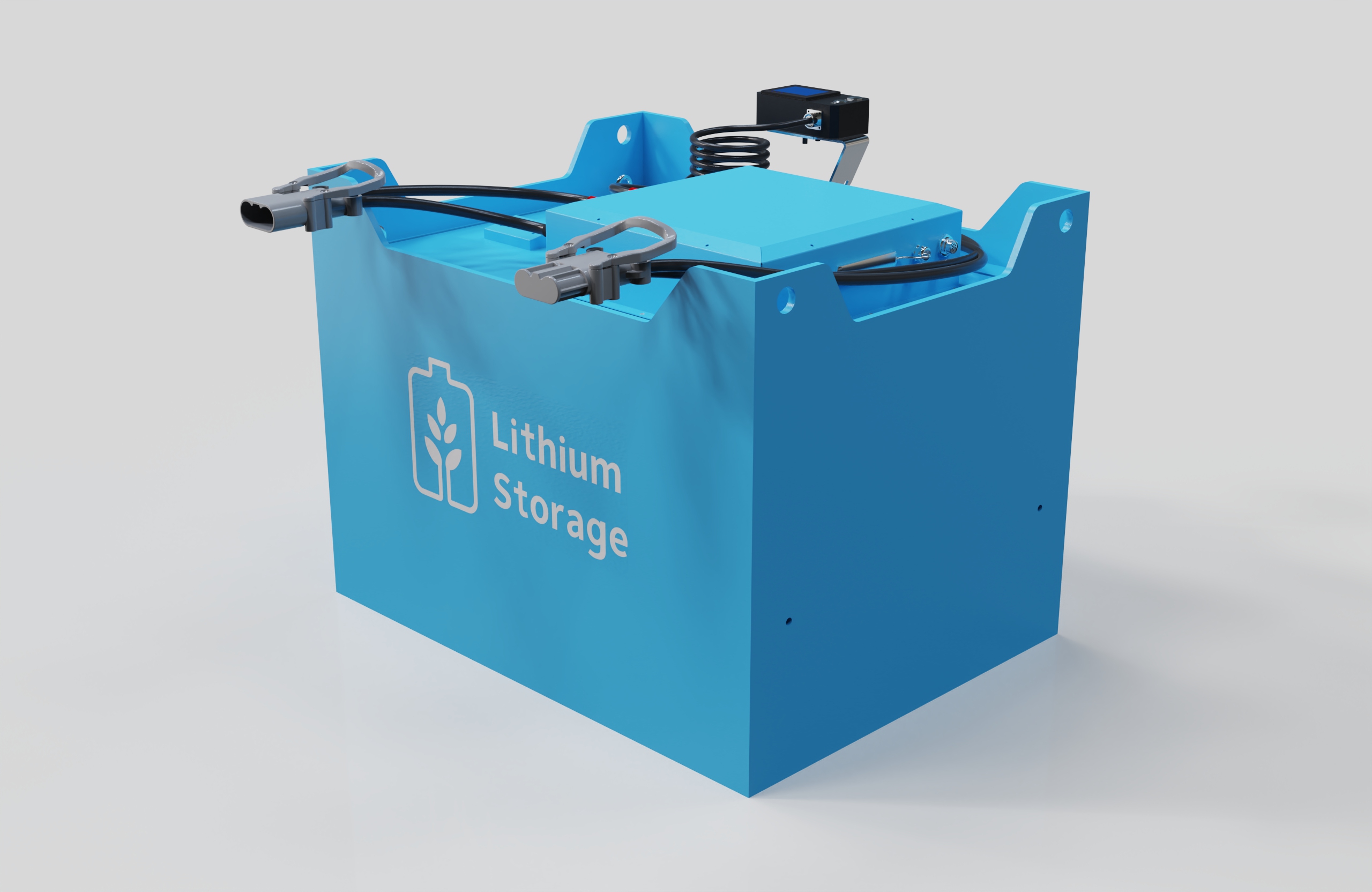
LITHIUM STORAGE supplies customized LiFePO4 forklift batteries for pallet trucks, reach trucks, stackers, counterbalance forklifts, and other electric material-handling equipment. Its battery systems use BMS monitoring and can support remote alarms and operating-data monitoring on selected configurations.
1. The Battery Is Getting Unusually Hot
Some heat generation during high-current operation and charging is normal. However, a battery that becomes noticeably hotter than usual deserves immediate attention.
Possible causes include:
Excessive charging current
Repeated high-current discharge
Poor electrical connections
Abnormal internal resistance
Insufficient battery capacity for the workload
High ambient temperature
Cell or module imbalance
The BMS in an industrial lithium battery monitors battery temperature and can limit or interrupt charging or discharging when programmed thresholds are reached. Repeated operation close to these protection limits can still accelerate battery aging even when the BMS prevents an immediate failure.
A single temperature warning during an unusually demanding shift may not indicate battery failure. However, repeated high-temperature alarms under normal operating conditions should be investigated.
If the enclosure becomes abnormally hot, begins smoking, produces unusual odors, or shows other signs of a serious thermal event, stop using the equipment and follow the site's emergency and battery-supplier procedures.
2. Runtime Suddenly Drops
Gradual capacity loss is expected as lithium-ion batteries age. A sudden reduction in operating time is different.
For example, if a forklift normally runs for five hours before requiring an opportunity charge but now lasts only three hours under a similar workload, there may be an underlying problem.
Possible causes include:
A weak or imbalanced cell
Incomplete charging
Charger communication problems
Incorrect SOC calculation
Increased internal resistance
Temperature-related power restriction
An unusually demanding duty cycle
An Electric Forklift Battery should be evaluated using operating data rather than runtime alone. A forklift handling heavier loads, climbing ramps more frequently, or operating in a cold store will naturally consume more energy.
Modern BMS systems can provide information such as individual cell voltage, battery voltage, current, temperature, SOC, state of health, fault history, and charging records. This data makes it easier to distinguish normal operational variation from developing battery problems.
3. The BMS Keeps Reporting the Same Fault
One of the biggest mistakes operators can make is repeatedly resetting an alarm without determining why it occurred.
A lithium forklift battery BMS can monitor conditions including:
It may reduce current, disconnect the battery, or prevent charging when operating limits are exceeded.
Repeated alarms can indicate a persistent problem rather than an isolated event.
For example:
Repeated undervoltage alarms may indicate that the battery is being discharged too deeply, has insufficient usable capacity, or contains a cell group behaving differently from the rest.
Repeated overcurrent alarms may indicate that the battery is undersized for forklift acceleration, heavy lifting, ramp operation, or hydraulic attachments.
Repeated temperature alarms may point to operating stress, poor connection quality, or thermal-management problems.
Repeated communication faults can originate from CAN wiring, connectors, incompatible software, charger configuration, or the forklift controller.
Persistent BMS faults should therefore be reviewed by trained service personnel rather than simply cleared.
4. The Battery Stops Charging or Charges Intermittently
A forklift battery that repeatedly starts and stops charging requires attention.
The cause may not necessarily be inside the battery. Lithium charging depends on several components working together:
Battery → BMS → connector → charger → communication system → AC power supply
A problem anywhere in this chain can create charging faults.
Check whether the problem occurs:
With only one battery
With only one charger
At a particular charging station
At low or high battery temperature
After a certain SOC is reached
When the cable or connector is moved
Modern lithium forklift batteries commonly communicate with chargers through CAN bus. The BMS can request allowable charging current according to cell voltage, temperature, SOC, and protection status. A communication or sensor fault can therefore cause charging current to be restricted or stopped.
Do not replace the battery automatically before confirming whether the charger or communication system is causing the fault.
5. Charging Takes Much Longer Than Before
Charging time naturally changes according to starting SOC, charger current, battery temperature, and cell-balancing activity.
However, if the same Electric Forklift Battery consistently takes significantly longer to charge under similar conditions, technical inspection may be justified.
Potential reasons include:
Charger output has decreased
BMS is limiting charge current
Battery temperature is outside the preferred range
One cell approaches its voltage limit earlier than others
Cell balancing requires more time
Battery resistance has increased with age
LITHIUM STORAGE explains that lithium battery charging current does not necessarily remain constant throughout the charging cycle. The BMS may reduce current when a cell approaches maximum voltage, battery temperature is outside its preferred range, the pack approaches full SOC, or a fault is detected.
Therefore, longer charging should be diagnosed using battery and charger data rather than simply increasing charger output.
6. Connectors or Cables Show Signs of Overheating
A battery can be healthy internally while still experiencing problems at its electrical connections.
Warning signs include:
Connector discoloration
Melted or deformed plastic
Burn marks
Loose terminals
Damaged cable insulation
Unusual warmth near the connector
Arcing marks
Intermittent power or charging
High-resistance connections can generate heat when large currents pass through them.
Forklifts can demand substantial current during acceleration, lifting, direction changes, ramp climbing, and simultaneous travel and hydraulic operation.
A damaged high-current connector should not simply be pushed back together and returned to service. The connector, cable, contacts, crimping, and mating half should be inspected and repaired or replaced according to the manufacturer's procedure.
This is particularly important in opportunity-charged fleets where connectors may be plugged and unplugged several times every shift.
7. The Battery Enclosure Is Damaged
Forklift batteries operate in demanding environments where impact is possible.
Battery damage may occur during:
Forklift collisions
Incorrect installation or removal
Vehicle tip-over
Handling with lifting equipment
Contact with racks or obstacles
Severe vibration
Inspect the enclosure for:
Significant dents
Cracks
Deformation
Loose mounting hardware
Damaged covers
Exposed cables
Water ingress
Broken connectors
A damaged enclosure does not automatically mean the internal cells are damaged, but significant deformation should not be ignored.
The battery case protects cells, modules, busbars, the BMS, contactors, wiring, and other high-energy electrical components. If physical damage could have affected these components, the battery should be removed from normal operation until it has been evaluated by qualified personnel.
8. SOC Changes Abnormally
The state-of-charge display should decline in a reasonably predictable way under similar operating conditions.
Possible warning signs include:
SOC suddenly drops from 50% to 20%
SOC remains at the same value for an unusually long time
Battery shuts down while the display still shows substantial charge
SOC jumps significantly after restarting
Forklift and battery displays show different values
These symptoms may indicate:
LITHIUM STORAGE's smart forklift battery systems can monitor battery status and operating records and can provide remote alarms and early warnings through supported cloud-connected configurations.
For fleet managers, historical SOC and fault data can be particularly useful because they show whether the behavior is a single incident or a repeating pattern.
9. Power Drops During Heavy Lifting or Acceleration
A forklift may appear normal during light driving but lose power when:
These operations create higher short-term current demand.
If the battery voltage falls excessively under load, the BMS may reduce power or trigger a low-voltage or overcurrent protection event.
The cause could be:
Battery undersizing: The pack may have enough kWh but insufficient peak-current capability.
Low SOC: Current capability may be restricted near the lower operating limit.
Low temperature: Internal resistance rises in cold conditions.
Aging: Increased cell resistance may create greater voltage sag.
Cell inconsistency: One cell may reach its lower voltage threshold before the rest of the pack.
Battery suppliers should specify both continuous and peak discharge current, along with the permitted peak duration and any current derating at low SOC or extreme temperatures.
Repeated power limitation under a workload the battery previously handled normally is a reason to request service diagnostics.
10. The Forklift Battery Repeatedly Shuts Down
A lithium battery suddenly disconnecting during operation should not be treated as normal behavior.
The BMS may open the contactor when it detects unsafe electrical or thermal conditions. Depending on the system, possible triggers include:
BMS protection is designed to prevent operation outside predefined limits, but the protection event itself does not explain why the limit was reached.
A forklift that repeatedly shuts down and restarts should therefore receive diagnostic attention rather than simply being returned to service after each reset.
When Should You Stop Using the Battery Immediately?
Some symptoms justify removing the battery or forklift from normal operation until it can be inspected.
These include:
| Warning Sign | Recommended Response |
|---|
| Smoke, fire, or strong abnormal odor | Stop operation and follow site emergency procedures |
| Severe overheating | Stop use and isolate according to approved procedures |
| Major enclosure deformation | Do not continue normal operation before inspection |
| Melted or burned connector | Disconnect from service and inspect |
| Repeated automatic shutdown | Retrieve fault data and arrange technical diagnosis |
| Persistent high-temperature alarm | Investigate load, battery, charger, and connections |
| Water intrusion or major contamination | Have the battery inspected before reuse |
| Abnormal swelling or structural change | Remove from service and contact qualified support |
Operators should not open the battery enclosure or attempt cell-level repairs themselves. Forklift lithium batteries contain high-energy DC circuits and should be serviced using the manufacturer's procedures by appropriately trained personnel.
Servicing Does Not Always Mean Replacing the Battery
A warning sign does not automatically mean the complete battery has reached end of life.
The underlying issue could involve:
This is why good diagnostic information is valuable.
Before contacting the battery supplier, record:
Forklift brand and model
Battery serial number
Current SOC
Fault code
Battery temperature
When the fault occurs
Whether it occurs while charging or discharging
Forklift load at the time
Charger model
Photos of connectors or physical damage
Recent changes to the forklift or charging system
For connected batteries, operating logs can provide an even clearer picture. LITHIUM STORAGE states that its smart battery platform can support real-time operating records, remote alarms, software and hardware traceability, BMS software updates, and parameter management on supported systems.
Prevent Problems with Regular Battery Checks
Lithium forklift batteries eliminate watering and many other lead-acid maintenance procedures, but regular inspection is still necessary.
Warehouse operators should routinely check:
This shift from electrolyte maintenance to inspection and system monitoring is an important difference between lithium-ion and traditional lead-acid forklift batteries.
For larger fleets, monitoring fault history, maximum temperature, equivalent full cycles, charging behavior, and repeated low-voltage or overcurrent events can help identify batteries requiring attention before forklift availability is affected.
Know When Your Electric Forklift Battery Needs Attention
A reliable Electric Forklift Battery should deliver predictable runtime, stable power, controlled charging, and consistent communication with the forklift and charger. When that behavior changes noticeably, the battery system deserves investigation.
The most important warning signs are:
Repeated overheating
Sudden runtime loss
Recurring BMS faults
Intermittent or failed charging
Increasing charging time
Hot or damaged connectors
Physical enclosure damage
Abnormal SOC readings
Unexpected power limitation
Repeated battery shutdowns
LITHIUM STORAGE manufactures customized LiFePO4 forklift battery solutions with BMS monitoring, charger and vehicle communication, and optional smart remote-monitoring functions for different material-handling platforms.
Recognizing abnormal battery behavior early makes servicing easier and helps fleet operators distinguish a relatively simple connector or communication issue from a battery condition that requires more extensive technical attention.
 EN
EN
 fr
fr  de
de  it
it  ru
ru  es
es  pt
pt  tr
tr  jp
jp  ar
ar  th
th 


 No.9 East Mozhou Road, Jiangning District, 211111, Nanjing City, China