Warehouse battery selection in 2026 is no longer based only on voltage and amp-hour capacity. Fleet managers also need to consider truck compatibility, operating hours, charging windows, battery weight, communication protocols, working temperature, and remote fleet management.
There is no single lithium-ion battery that is best for every warehouse. A compact pallet jack and an 80V electric counterbalance forklift have completely different power requirements. The following five battery configurations are ranked by their suitability for common warehouse operations rather than audited sales volume.
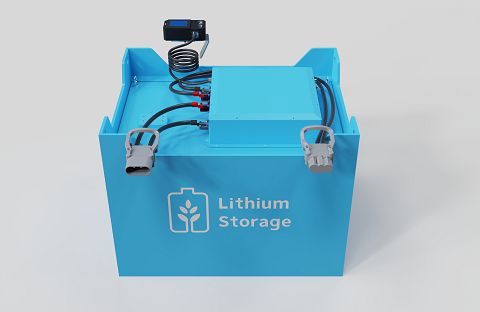
Top 5 Forklift Battery Configurations
| Battery Configuration | Nominal Energy | Best Suited For | Main Selection Advantage |
|---|
| 25.6V 206Ah | 5.27kWh | Electric pallet jacks and compact warehouse trucks | Compact size and sufficient energy for short-distance material transport |
| 25.6V 304Ah | 7.78kWh | Electric stackers and frequently used pallet trucks | Higher runtime within a 24V platform |
| 38.4V 684Ah | 26.27kWh | 36V reach trucks and existing narrow-aisle fleets | High capacity for demanding warehouse shifts |
| 51.2V 456Ah | 23.35kWh | 48V electric counterbalance forklifts | Balanced capacity for lifting and travel |
| 83.2V 412Ah | 34.28kWh | High-throughput electric counterbalance forklifts | Higher available energy for intensive operations |
The correct battery must still match the forklift’s rated voltage, battery compartment, minimum battery weight, connector, charger, and CAN communication requirements.
1. 25.6V 206Ah Lithium Battery: Best for Compact Pallet Jacks
A 25.6V 206Ah lithium battery is a practical option for electric pallet jacks used for short-distance pallet movement, loading-dock support, order preparation, and replenishment work.
This configuration provides approximately 5.27kWh of nominal energy. It is most suitable for equipment that operates intermittently or has regular opportunities to recharge during breaks.
Typical applications include:
Walk-behind electric pallet trucks
Compact rider pallet trucks
Light electric stackers
Retail distribution warehouses
Loading and unloading areas
Short-route internal transport
Lithium Storage lists a 25.6V 206Ah Smart FLT battery with CAN communication support, configurable connectors, optional additional weight, GPS and GPRS functions, and multiple enclosure arrangements. The battery is designed for pallet-truck applications and can be configured around different physical installation requirements.
Why It Stands Out
The main advantage of this battery is not maximum capacity but operational flexibility. Its compact energy range is suitable for warehouses where pallet trucks return frequently to fixed work areas and can be connected to a charger during scheduled downtime.
Opportunity charging is particularly useful for lithium-ion equipment because operators can charge the truck during lunch breaks, shift changes, or other idle periods without performing a battery exchange. Toyota notes that this method allows lithium-ion batteries to remain in the forklift across multiple shifts while using normal breaks for charging.
Choose This Battery When
Select a 25.6V 206Ah battery when the truck is designed for a 24V system, daily travel distances are moderate, and reliable charging opportunities are available.
A larger battery should be considered when the equipment operates continuously, covers long warehouse routes, or has limited access to charging.
2. 25.6V 304Ah Lithium Battery: Best for High-Use Stackers
The 25.6V 304Ah configuration provides approximately 7.78kWh of nominal energy. It keeps the same 24V-class electrical platform as smaller pallet-truck batteries while offering more stored energy.
This makes it suitable for:
Electric pallet stackers
High-lift walkie stackers
Rider stackers
Pallet trucks operating longer routes
Warehouses with fewer charging breaks
Equipment performing both travel and frequent lifting
Lithium Storage’s 25.6V 304Ah battery is configured for warehouse equipment such as the Linde L16AP platform. Its listed features include IP54 construction, CAN-enabled charger matching, customizable discharge connectors, communication commissioning, and additional-weight options.
Why It Stands Out
This battery suits operations that need more runtime but cannot change from a 24V electrical system. The extra capacity can support more lifting cycles, longer travel distances, or reduced dependence on midday charging.
However, fleet managers should not select 304Ah simply because it is larger than 206Ah. The battery compartment must have enough space, and the truck must support the resulting battery dimensions and weight.
Choose This Battery When
A 25.6V 304Ah battery is appropriate when:
The forklift data plate specifies a 24V battery.
A 206Ah battery does not provide sufficient runtime.
The truck performs regular hydraulic lifting.
Opportunity charging is available but not frequent.
The warehouse wants to avoid battery changes during a shift.
For a low-use pallet jack, this capacity can be unnecessary. For continuous three-shift operation, it can still be insufficient unless supported by a properly planned charging schedule.
3. 38.4V 684Ah Lithium Battery: Best for Existing 36V Reach-Truck Fleets
Although 24V, 48V, and 80V platforms are widely used, many warehouses continue to operate 36V reach trucks, narrow-aisle forklifts, and rider equipment. Replacing these trucks is not always necessary when a compatible lithium battery can extend their operational usefulness.
A 38.4V 684Ah lithium battery provides approximately 26.27kWh of nominal energy. This is a much larger energy reserve than compact 24V batteries and is suitable for trucks with longer shifts, higher lift requirements, and more demanding travel patterns.
Lithium Storage lists this battery configuration for the Crown RR5700 platform. The specified solution includes an IP54 enclosure, connector adaptation, additional-weight options, CAN communication, and remote-support functions.
Why It Stands Out
The main value of this configuration is compatibility with existing 36V fleets. Warehouses often have specialized reach trucks that remain mechanically serviceable but rely on aging lead-acid batteries.
A correctly engineered lithium replacement can reduce the need for battery watering, equalization, battery-room labor, and mid-shift battery exchanges. Lithium-ion forklift batteries are generally designed for maintenance-free operation and flexible charging, while integrated battery and charger systems reduce compatibility risks.
Choose This Battery When
This configuration is worth considering when:
The forklift is specifically designed for a 36V battery.
The existing lead-acid battery has a high Ah rating.
The truck requires substantial counterweight.
The warehouse wants to retain an established reach-truck fleet.
Long lifting cycles and multi-shift use demand higher stored energy.
A 36V truck should not be converted to 48V without approval from the forklift manufacturer or a qualified engineering team. The controller, motors, wiring, instruments, and charger are designed around a defined voltage range.
4. 51.2V 456Ah Lithium Battery: Best All-Round Choice for 48V Forklifts
The 51.2V 456Ah battery is the most versatile configuration on this list for medium-duty warehouse operations. It provides approximately 23.35kWh of nominal energy and can support a combination of travel, lifting, acceleration, and attachment use.
Common applications include:
Electric counterbalance forklifts
Medium-capacity warehouse forklifts
Indoor loading and unloading
Manufacturing warehouses
Distribution centers
Multi-shift operations with opportunity charging
Lithium Storage offers a 51.2V 456Ah Smart FLT battery configured for equipment including the Still RX20-18. The available design includes IP54 protection, selectable enclosure and weight arrangements, CAN-compatible charging, connector customization, and remote-support functions.
Why It Stands Out
A 48V-class battery provides a useful balance between system power and available capacity. It is suitable for many warehouses that need more performance than a pallet truck but do not require an 80V heavy-duty platform.
This battery is especially relevant when the truck operates across two or more shifts and can receive partial charges during scheduled breaks. Lithium-ion charging does not require the same watering, equalization, or battery-cooling routines associated with traditional flooded lead-acid batteries. Toyota identifies faster charging, opportunity charging, and reduced routine maintenance as important operational advantages for warehouse lithium-ion systems.
Choose This Battery When
A 51.2V 456Ah battery is suitable when:
The truck requires a 48V battery.
The operation combines frequent lifting and medium-to-long travel.
The warehouse runs more than one shift.
Operators can charge during breaks.
The battery must communicate with the truck and charger.
Stable performance throughout the shift is important.
Capacity still needs to be calculated from actual energy consumption. Two warehouses using the same forklift model can require different battery capacities because of load weight, travel distance, lift height, attachments, floor conditions, and shift length.
5. 83.2V 412Ah Lithium Battery: Best for High-Throughput Counterbalance Forklifts
The 83.2V 412Ah configuration offers approximately 34.28kWh of nominal energy, making it the highest-energy option among these five batteries.
It is intended for more demanding electric counterbalance forklift applications, including:
High-volume distribution centers
Frequent loading-dock operations
Long warehouse travel routes
Repetitive lifting at high capacity
Multi-shift material handling
Applications using hydraulic attachments
Operations with limited tolerance for downtime
Lithium Storage’s listed 83.2V 412Ah battery is designed for electric counterbalance forklifts and supports CAN-enabled charging, connector configuration, optional additional weight, IP54 construction, and vehicle communication.
Why It Stands Out
This battery provides more available energy for equipment that combines demanding traction and hydraulic workloads. An 80V-class platform can support intensive operations when the forklift is designed for that voltage.
The advantage does not come from voltage alone. The battery’s usable energy, continuous discharge current, peak current, thermal management, charging rate, and truck integration all determine its actual performance.
Choose This Battery When
Consider an 83.2V 412Ah system when:
The forklift is rated for an 80V battery.
The equipment handles heavy or repetitive loads.
Travel distances are long.
The truck operates for extended periods.
Opportunity or fast charging is planned.
The battery must support high traction and hydraulic demand.
An 80V battery is not an upgrade for a 48V forklift. Installing the wrong voltage can damage electrical components and create serious operational risks.
What Makes a Good Warehouse Forklift Battery in 2026?
Beyond voltage and capacity, warehouse buyers should evaluate the following factors.
Battery and Truck Communication
The battery management system should communicate correctly with the forklift controller, charger, display, and safety interlocks. CAN protocol requirements can differ between truck brands and models.
Remote Battery Monitoring
Connected battery platforms are becoming more useful for larger fleets. Lithium Storage states that its 4G-enabled remote platform can transmit voltage, temperature, state of charge, location, fault alerts, and operating data to web or mobile interfaces.
This can help warehouse managers identify undercharged trucks, irregular energy use, overheating events, and batteries that require technical attention.
Battery Weight
The original lead-acid battery often contributes to the forklift’s counterweight. A lithium battery must meet the truck manufacturer’s minimum battery-weight requirement.
Additional ballast or a customized outer enclosure can be required even when voltage and capacity are correct.
Charging Infrastructure
The battery, charger, connector, communication protocol, and available AC power supply should be evaluated as one system. Hyster emphasizes that the lift truck, lithium-ion battery, and charger should be designed and tested to operate together.
Cold-Storage Performance
Cold warehouses require more than a standard battery pack. Depending on operating and charging temperatures, the battery can require insulation, heating, enhanced moisture protection, or customized charging controls.
Lithium Storage identifies IP66 enclosures, insulation, charging-heating systems, and optional discharge heating as possible configurations for sub-zero warehouse operations.
How to Select from These Five Batteries
Use the following process before requesting a quotation:
Confirm the forklift’s rated battery voltage.
Record the current battery’s Ah rating, dimensions, and weight.
Measure the battery compartment.
Identify the forklift brand, model, and serial number.
Calculate operating hours and energy use per shift.
Record average load, maximum load, and lift height.
Confirm the connector type and cable position.
Check the truck and charger communication protocol.
Define available charging windows.
Specify temperature, moisture, and cold-storage conditions.
The best battery is the smallest correctly engineered system that can complete the required workload with an acceptable charging margin. Oversizing increases cost and weight, while undersizing creates frequent charging interruptions and deeper discharge cycles.
Why the Forklift Battery Manufacturer Matters
A warehouse battery is not an interchangeable box selected only by voltage. A capable Forklift Battery Manufacturer should be able to configure:
Battery voltage and capacity
Continuous and peak discharge current
Outer enclosure dimensions
Minimum counterweight
Charge and discharge connectors
Cable position and length
CAN communication
BMS settings
Charger output
Display and alarm functions
Heating and cold-storage protection
Remote monitoring
Lithium Storage supplies 24V, 36V, 48V, and 80V Smart FLT lithium-ion battery systems. Its product range includes configurations for pallet trucks, stackers, reach trucks, and electric counterbalance forklifts, along with charger matching and battery customization for different brands and models.
Frequently Asked Questions
Which lithium-ion forklift battery is best for a warehouse?
The best option depends on the forklift’s rated voltage and daily duty cycle. A 25.6V battery is commonly suited to pallet trucks and stackers, while 51.2V and 83.2V batteries are more relevant to electric counterbalance forklifts with higher power requirements.
Is a higher-voltage forklift battery always better?
No. The battery voltage must match the forklift’s electrical system. An 80V battery is suitable only for a truck designed to operate on an 80V platform.
Should buyers compare Ah or kWh?
Use Ah when comparing batteries at the same voltage. Use kWh when comparing total stored energy across different voltage platforms.
The calculation is:
Nominal energy in kWh = voltage × amp-hours ÷ 1,000
Can lithium forklift batteries be charged during breaks?
Yes, when the battery, charger, and operating procedure are designed for opportunity charging. Breaks and shift changes can be used to restore part of the consumed energy without removing the battery from the truck.
Can one battery fit several forklift brands?
It is possible when the trucks share compatible voltage, dimensions, weight, connectors, discharge-current requirements, and communication protocols. Compatibility should be confirmed by model rather than brand name alone.
Final Recommendation
For compact pallet-jack operations, the 25.6V 206Ah configuration offers a practical starting point. Warehouses needing longer runtime from 24V stackers can consider the 25.6V 304Ah option. Existing 36V reach-truck fleets can benefit from a properly configured 38.4V 684Ah battery, while the 51.2V 456Ah system provides a balanced solution for many medium-duty electric forklifts. High-throughput counterbalance operations should evaluate an 83.2V 412Ah battery when the truck is designed for an 80V platform.
Before placing an order, work with an experienced Forklift Battery Manufacturer to verify the complete battery, forklift, charger, connector, communication, and counterweight system. Correct configuration is more important than choosing the largest battery on the specification sheet.
 EN
EN
 fr
fr  de
de  it
it  ru
ru  es
es  pt
pt  tr
tr  jp
jp  ar
ar  th
th 

 No.9 East Mozhou Road, Jiangning District, 211111, Nanjing City, China