Selecting the correct lithium forklift battery voltage is not simply a matter of choosing a higher-powered battery. The battery must match the electrical system, motor controller, charger, physical structure, and operating requirements of the forklift.
Most electric material-handling equipment uses a 24V, 36V, 48V, or 80V battery system. However, the correct voltage depends primarily on the forklift manufacturer’s specifications rather than load capacity alone. Before purchasing a Lithium Ion Forklift Battery, fleet managers should confirm the rated voltage of every truck and evaluate its daily workload, charging schedule, battery compartment, and communication requirements.
Start with the Forklift’s Rated Voltage
The first step is to check the forklift data plate, service manual, or existing battery label. These sources normally identify the rated battery voltage required by the truck.
A 24V forklift should generally use a 24V replacement battery, while a truck designed for 48V should use a compatible 48V system. A battery with a different voltage should not be installed unless the forklift manufacturer or a qualified engineering team has approved a complete electrical conversion.
Changing the voltage without evaluating the truck can affect:
Traction and hydraulic motor performance
Motor controller operation
Wiring and connector current ratings
Dashboard and control electronics
Regenerative braking
Charger compatibility
BMS communication
Electrical protection settings
Forklift manufacturers commonly configure trucks around specific voltage platforms. For example, Toyota states that its electric walkie pallet jacks typically operate on 24V systems, while Linde uses 48V technology in several electric counterbalance forklift ranges. Hyster offers certain electric forklift models with 36V, 48V, or 80V configurations, depending on the model and application.
Common Lithium Forklift Battery Voltages
The following table provides a general reference. Actual requirements must always be confirmed against the individual forklift model.
| Battery Voltage | Common Equipment Types | Typical Operating Conditions |
|---|
| 24V | Electric pallet jacks, walkie stackers, compact order pickers and light warehouse trucks | Short-distance transport, loading areas, retail warehouses and light-duty operations |
| 36V | Some narrow-aisle trucks, rider pallet trucks and older electric forklift platforms | Fleets replacing existing 36V lead-acid batteries |
| 48V | Reach trucks, medium-capacity counterbalance forklifts and warehouse forklifts | Regular lifting, longer travel distances and medium-duty multi-shift operations |
| 80V | Higher-capacity counterbalance forklifts and demanding material-handling equipment | Heavy loads, frequent acceleration, longer travel and intensive lifting cycles |
These classifications are useful starting points, but they are not universal. The same general forklift type can be offered with different voltage options. Toyota, for example, supplies lithium-ion solutions in 24V, 36V and 48V configurations, while Hyster lithium-ion options are available for selected 24V, 48V and 80V trucks.
When to Choose a 24V Forklift Battery
A 24V lithium forklift battery is commonly used in compact warehouse equipment with relatively low traction and hydraulic power requirements.
Typical applications include:
Walk-behind pallet trucks
Rider pallet trucks
Electric stackers
Low-level order pickers
Compact warehouse transporters
Some automated material-handling vehicles
Many pallet trucks and stackers operate on 24V platforms because the voltage is sufficient for short-distance transport and moderate lifting while allowing a compact battery design. Jungheinrich, for example, lists several pallet trucks and stackers with 24V electrical systems.
However, two 24V batteries can have very different runtime and current-delivery capabilities. Battery capacity, peak discharge current, truck weight requirements and available charging time must still be calculated.
When to Choose a 36V Forklift Battery
A 36V system is found more frequently in certain North American forklift fleets, older sit-down electric trucks and some narrow-aisle equipment.
When replacing a 36V lead-acid battery with lithium, keeping the same system voltage is normally the safest approach. The lithium battery must also be configured to work with the forklift’s:
Although 36V is less common in some newer product ranges than 24V, 48V and 80V, it remains important for fleets operating legacy equipment. Fleet managers should not automatically convert a 36V truck to 48V simply because 48V batteries are more widely available.
When to Choose a 48V Forklift Battery
A 48V lithium battery is widely used in reach trucks, electric counterbalance forklifts and equipment requiring more traction or hydraulic power than compact pallet trucks.
It is often appropriate for:
Medium-capacity electric counterbalance forklifts
Reach trucks
High-lift warehouse trucks
Equipment covering longer travel distances
Trucks operating with demanding attachments
Regular two-shift or multi-shift warehouse work
Linde uses 48V drive technology in several electric counterbalance forklift models and identifies 48V as a common platform for forklift trucks and reach-truck applications.
A 48V system can deliver a given amount of power at a lower current than a 24V system. However, this does not mean that any fleet should upgrade to 48V. The truck must already be designed for that voltage.
When to Choose an 80V Forklift Battery
An 80V lithium forklift battery is often selected for heavier electric counterbalance forklifts and intensive applications involving frequent travel, acceleration and hydraulic operation.
Common operating conditions include:
Heavy or repetitive material movement
Long travel routes
Frequent lifting to high racks
Multiple attachments
Inclines or loading ramps
Continuous multi-shift operations
Applications requiring sustained power output
Some Hyster electric forklift ranges use 48V systems for lower-capacity models and 80V systems for higher-capacity configurations. This illustrates how voltage can increase with the truck’s performance requirements, although the exact relationship varies by manufacturer.
An 80V battery should not be selected solely because it appears more powerful. It is suitable only when the forklift controller, motors, wiring, charger and auxiliary systems are designed for an 80V platform.
Do Not Confuse Voltage with Battery Capacity
Voltage and capacity describe different aspects of a forklift battery.
Voltage indicates electrical system compatibility.
Ampere-hours indicate the amount of charge stored.
Kilowatt-hours indicate the battery’s total nominal energy.
Nominal battery energy can be estimated using:
Energy in kWh = Voltage × Capacity in Ah ÷ 1,000
For example:
48V × 400Ah = 19.2kWh
80V × 250Ah = 20kWh
The two batteries have similar nominal energy even though their voltage and ampere-hour ratings are different.
This is why an 80V battery does not automatically provide longer runtime than a 48V battery. Runtime depends on the usable energy of the battery and the forklift’s actual energy consumption.
Evaluate the Fleet’s Duty Cycle
After confirming voltage compatibility, determine how much battery capacity each forklift requires.
Collect the following operating information:
Working Hours
Record how many hours each truck operates per shift and how many shifts it completes per day. A forklift used intermittently in a single shift has different requirements from one operating continuously across three shifts.
Load Profile
Consider both the average and maximum loads. Frequent transport at full rated capacity requires more energy than moving lighter loads.
Travel Distance
Long warehouse routes, outdoor yards and repeated loading-dock travel increase traction energy consumption.
Lift Height and Frequency
Frequent lifting to high rack levels increases hydraulic energy demand. Attachments such as clamps, rotators and fork positioners can add further consumption.
Floor Conditions and Gradients
Rough floors, ramps and inclines place additional demand on the traction system.
Operating Temperature
Cold-storage operations can affect battery performance and charging behaviour. The battery system may require low-temperature charging protection, insulation or heating functions.
Charging Opportunities
Lithium batteries can support opportunity charging during breaks, shift changes and other periods of inactivity. This can reduce the required battery capacity, provided the charger has sufficient output and the operating schedule includes reliable charging windows.
Check Battery Weight and Compartment Dimensions
Lead-acid batteries often function as part of the forklift’s counterweight. Lithium batteries have higher energy density and can be significantly lighter for an equivalent amount of usable energy.
For this reason, a lithium replacement must meet the forklift manufacturer’s minimum battery weight requirement. A battery that is electrically compatible but too light can affect truck stability and rated lifting capacity.
Before ordering, provide:
Battery compartment length, width and height
Maximum and minimum permitted battery dimensions
Minimum required battery weight
Existing battery weight
Battery removal direction
Cable outlet position
Connector model and orientation
Lifting-eye or fork-pocket requirements
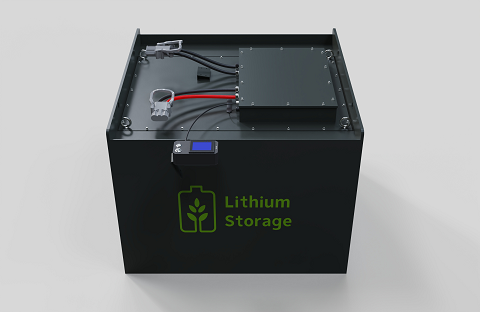
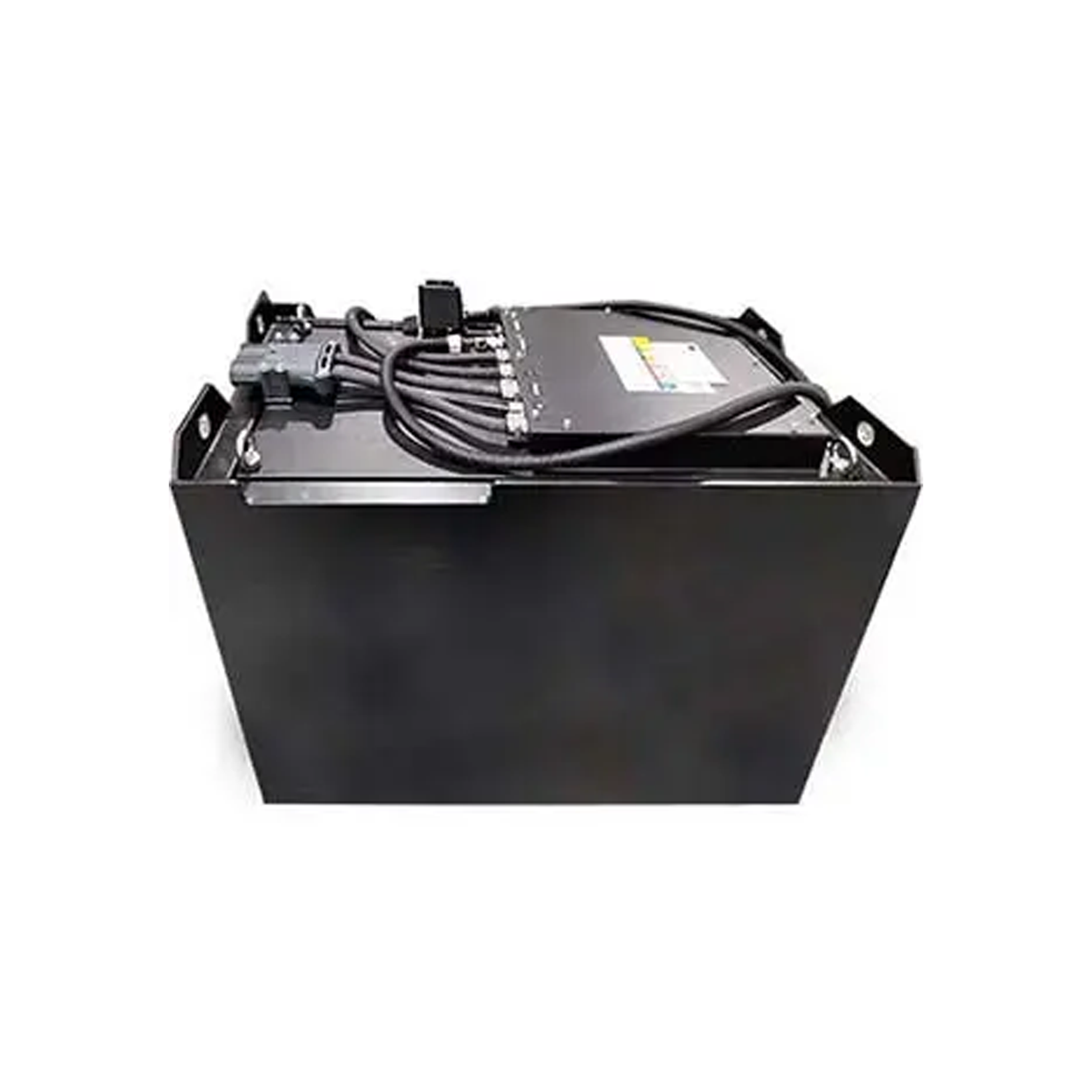
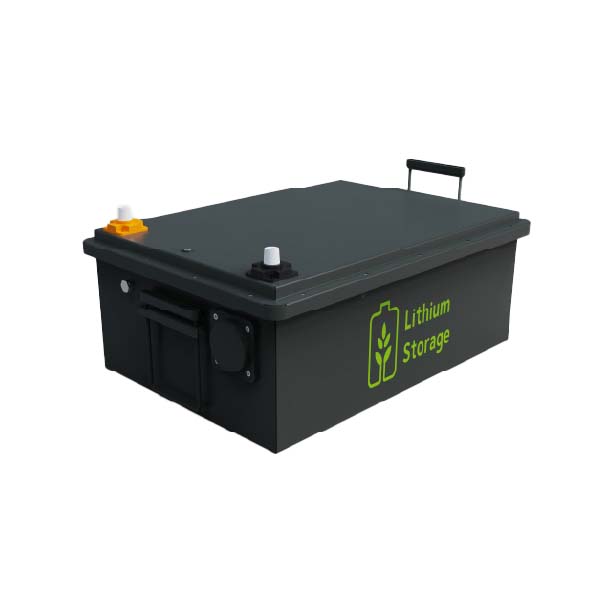
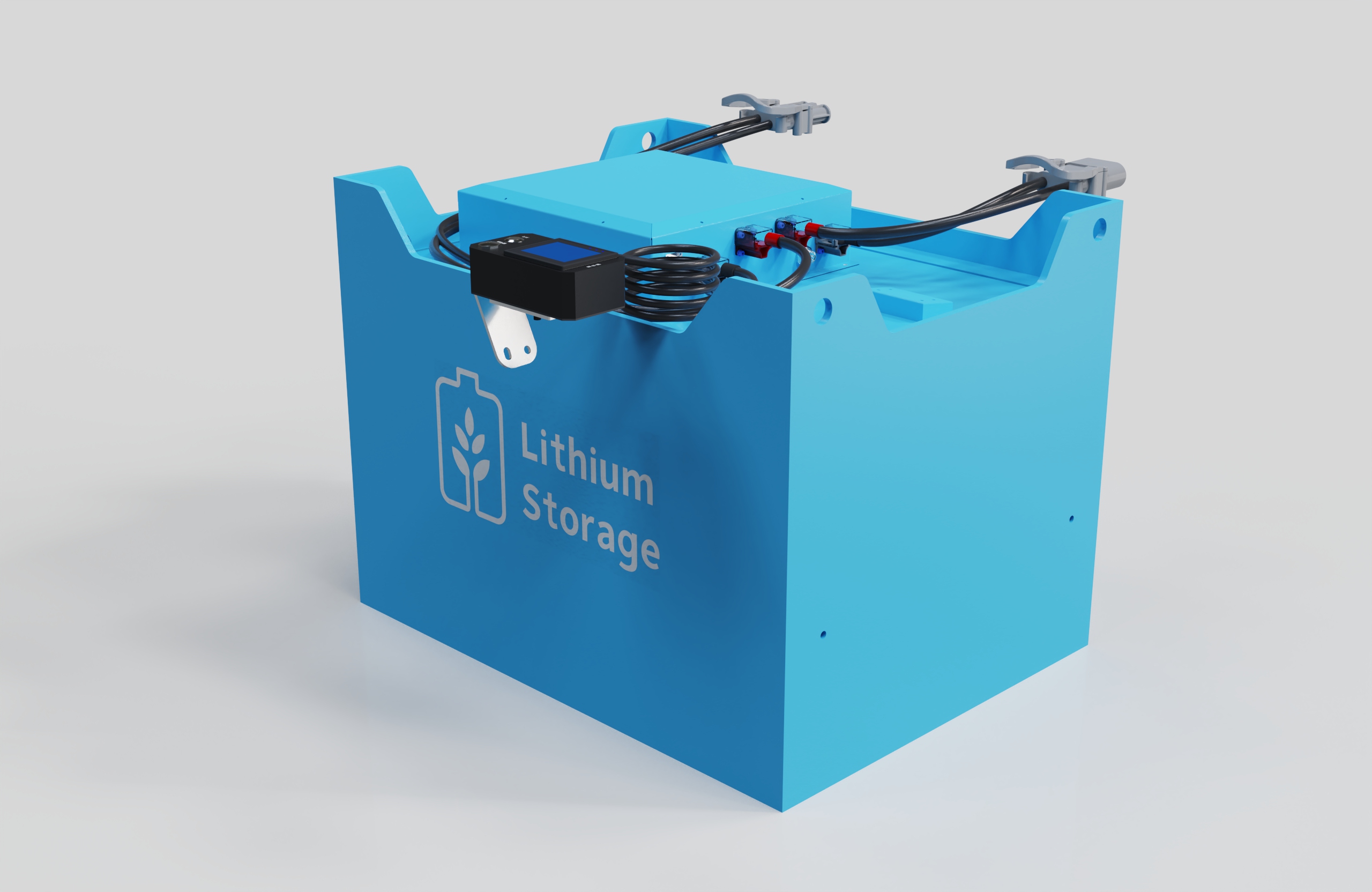
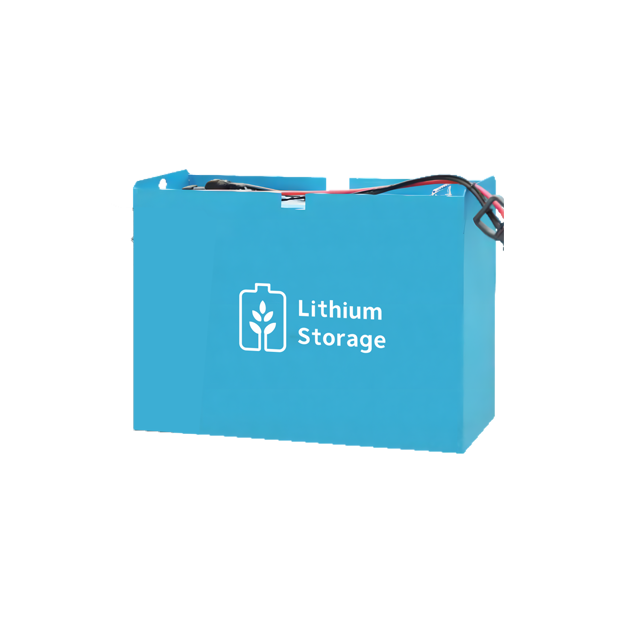
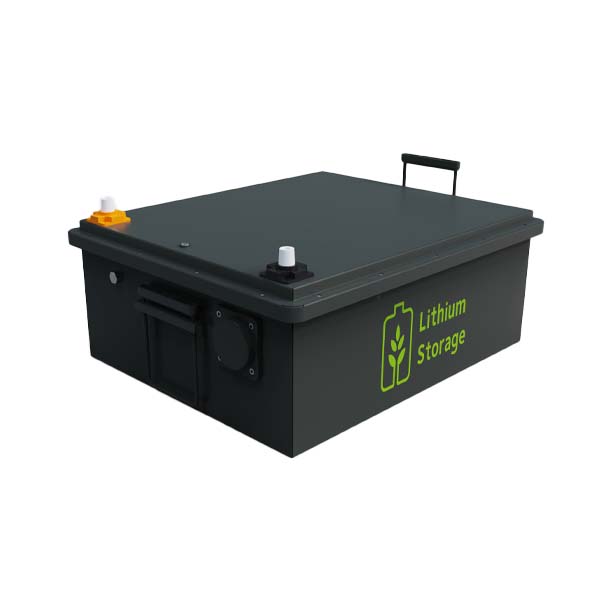
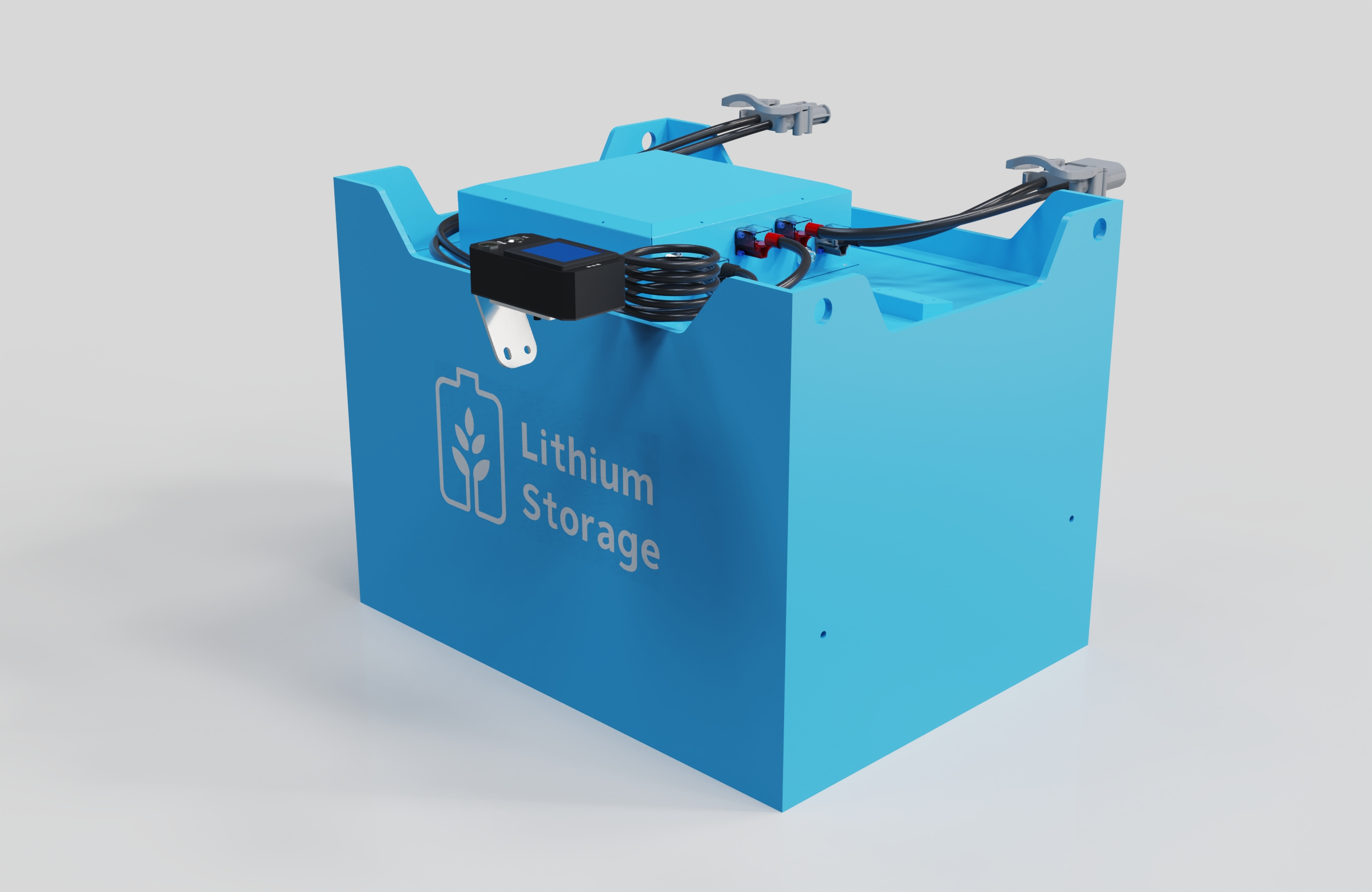
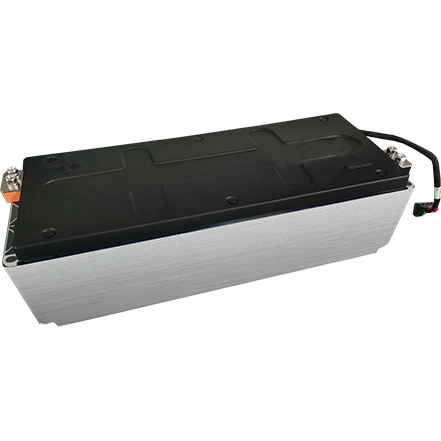
Lithium Storage offers 24V, 36V, 48V and 80V forklift battery ranges and can customize the battery enclosure, dimensions and additional weight for different forklift models. Its standard and customized solutions are intended to replace lead-acid batteries while fitting the truck’s physical and operational requirements.
Match the Battery with the Correct Charger
A lithium forklift battery requires a charger configured for its voltage, battery chemistry, capacity and BMS charging protocol.
Check:
Charger output voltage
Maximum charging current
AC input voltage and phase
Charging connector
CAN communication protocol
Maximum battery charging rate
Available charging time
Charger installation environment
A charger carrying the same voltage label is not automatically compatible. Its charging profile and communication system must also match the battery.
Multi-voltage forklift chargers are available and can support several battery voltage platforms. Crown, for example, offers charger configurations covering 24V, 36V, 48V, 72V, 80V and 96V. However, the correct charging profile, connector and communication settings must still be selected for each battery.
Consider BMS and Forklift Communication
Modern lithium forklift batteries use a battery management system to monitor and control:
Some forklifts require communication between the BMS, charger and truck controller through CAN bus or another interface. Without the correct communication protocol, the forklift can display inaccurate state-of-charge information, limit performance or refuse to operate.
Linde notes that its lithium-ion battery management system communicates with both the vehicle and charging equipment through a CAN bus interface. Hyster likewise emphasizes integrated communication among the truck, battery and charging system.
Managing a Mixed-Voltage Fleet
Large fleets often contain pallet trucks, stackers, reach trucks and counterbalance forklifts operating at different voltages. A voltage map can simplify replacement planning and charging infrastructure.
Create a fleet record containing:
| Fleet Information | Details to Record |
| Truck identification | Brand, model, serial number and asset number |
| Electrical system | Rated voltage and controller requirements |
| Existing battery | Voltage, Ah, weight and dimensions |
| Daily operation | Hours, shifts, loads and travel distance |
| Charging | Charger voltage, current, connector and input power |
| Communication | CAN protocol and BMS requirements |
| Environment | Indoor, outdoor, cold storage or high-temperature area |
Where practical, standardize battery models among forklifts with identical voltage, dimensions and communication requirements. This can simplify charger allocation, spare-parts management and operator training.
Do not standardize only by voltage. Two 48V forklifts can still require different battery sizes, weights, connectors, communication protocols and discharge-current limits.
Information to Provide When Requesting a Battery Recommendation
To receive an accurate lithium battery proposal, provide the supplier with:
Forklift brand and model
Forklift serial number or data-plate photograph
Existing battery voltage and capacity
Battery compartment dimensions
Existing battery weight
Minimum required battery weight
Connector type and cable position
Charger specifications
Operating hours per shift
Number of shifts per day
Average and maximum load
Working temperature
Available charging windows
Required communication protocol
This information allows the battery manufacturer to determine the correct voltage platform, capacity, enclosure, ballast, connector, BMS settings and charger.
Quick Voltage Selection Guide
Use the following sequence when selecting a forklift lithium battery:
Confirm the forklift’s rated voltage.
Keep the replacement battery at the same system voltage.
Calculate the required usable energy from the duty cycle.
Confirm peak and continuous discharge-current requirements.
Check battery compartment dimensions.
Verify minimum battery weight and counterbalance requirements.
Match the connector and cable arrangement.
Confirm BMS-to-truck communication.
Select a compatible lithium charger.
Validate the complete battery, charger and forklift system before operation.
Frequently Asked Questions
Can a 36V lead-acid forklift use a 48V lithium battery?
Not as a direct replacement. Battery chemistry does not change the forklift’s required system voltage. Converting from 36V to 48V requires an engineering review of the controller, motors, wiring, instruments, charger and protection systems.
Is an 80V forklift battery better than a 48V battery?
Not necessarily. An 80V system is suitable for forklifts designed around that voltage and can support demanding power requirements. A 48V battery is the correct choice for a truck designed for 48V. Compatibility is more important than selecting the highest voltage.
Does a higher Ah rating mean a longer runtime?
Generally, a higher Ah rating provides more stored energy when comparing batteries at the same voltage. When comparing different voltages, use kilowatt-hours rather than Ah alone.
Can the existing lead-acid charger charge a lithium forklift battery?
Usually not without verification or modification. Lithium batteries require a compatible charging profile and can also require BMS communication. The battery supplier should approve the charger before use.
Can one lithium battery model fit several forklift brands?
It is possible when the trucks share compatible voltage, battery dimensions, weight requirements, connectors and communication systems. Brand compatibility alone is not enough; each forklift model should be checked individually.
Choose Voltage First, Then Configure the Battery
The correct forklift battery voltage is determined by the truck’s electrical design. Fleet workload, operating time and charging opportunities then determine the capacity and charger requirements.
For most fleets, the selection process begins with 24V for compact warehouse trucks, 36V for certain existing platforms, 48V for many reach and medium-capacity counterbalance trucks, and 80V for more demanding electric forklift applications. These are general patterns rather than fixed rules.
A properly selected Lithium Ion Forklift Battery should match the forklift’s voltage, dimensions, weight, connector, communication protocol and daily duty cycle. Evaluating the complete truck-battery-charger system helps prevent compatibility problems and provides reliable power across the fleet.
 EN
EN
 fr
fr  de
de  it
it  ru
ru  es
es  pt
pt  tr
tr  jp
jp  ar
ar  th
th 


 No.9 East Mozhou Road, Jiangning District, 211111, Nanjing City, China