A material handling battery should not be selected only by voltage, amp-hour capacity, or purchase price. It must fit the equipment physically, provide sufficient current for travel and lifting, meet the required counterweight, communicate with the vehicle and charger, and support the operation’s daily working schedule.
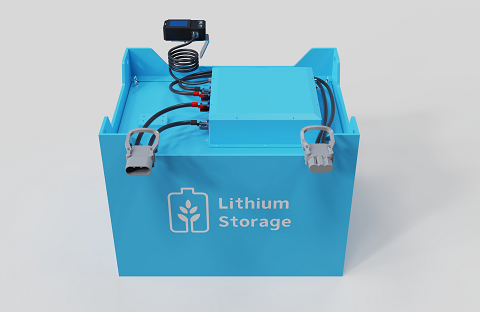
Lithium batteries are now used in electric pallet trucks, stackers, reach trucks, counterbalance forklifts, tow tractors, automated vehicles, and other warehouse equipment. However, these machines have different energy demands, battery compartments, voltage platforms, and charging requirements. LITHIUM STORAGE, for example, offers LiFePO4 material handling battery systems across 24V, 36V, 48V, and 80V classes, with different capacities for warehouse and industrial vehicles.
This guide explains the most important technical and commercial factors to evaluate before purchasing a lithium battery for material handling equipment.
Begin with the Equipment, Not the Battery Catalogue
The buying process should begin with the exact equipment that the battery will power.
Record the following information:
Equipment manufacturer and model
Serial number and production year
Rated battery voltage
Existing battery capacity
Existing battery dimensions
Existing battery weight
Battery compartment measurements
Connector type and cable position
Controller and communication requirements
Existing charger specifications
A battery advertised as compatible with a particular forklift brand is not automatically compatible with every model from that manufacturer. Two 48V trucks can require different dimensions, minimum weights, connectors, current limits, and communication protocols.
The safest approach is to provide the battery supplier with the equipment data plate, current battery label, compartment drawing, and photographs of the connector and cable layout.
Key Material Handling Battery Specifications
| Specification | What the Buyer Must Confirm |
|---|
| Voltage | Must match the vehicle’s electrical platform |
| Capacity | Must provide enough usable energy for the duty cycle |
| Continuous current | Must support normal driving and hydraulic operation |
| Peak current | Must cover acceleration, lifting, and ramp demand |
| Dimensions | Must fit the battery compartment and restraint system |
| Weight | Must meet the equipment’s counterbalance requirements |
| Chemistry | Should be clearly identified, such as LiFePO4 |
| BMS | Must provide suitable monitoring and protection |
| Communication | Must integrate with the vehicle, charger, and display |
| Charger | Must match voltage, charging current, and protocol |
| Connector | Must match the vehicle mechanically and electrically |
| Temperature range | Must suit the operating and charging environment |
| Enclosure protection | Must suit dust, moisture, and wash conditions |
| Documentation | Must meet transport and destination-market requirements |
| Warranty | Must clearly define time, hours, cycles, and exclusions |
| Service support | Must cover commissioning, diagnostics, and spare parts |
These specifications should be reviewed as one complete system. Hyster states that integrating the forklift, battery, and charger reduces software mismatches, charging faults, and other compatibility risks associated with separately sourced systems.
1. Select the Correct Voltage Platform
Voltage is the first specification to confirm because it determines whether the battery is electrically compatible with the equipment.
Common material handling battery classes include:
24V: pallet jacks, walkie stackers, compact order-picking equipment, and light warehouse trucks
36V: selected reach trucks, rider trucks, and established forklift platforms
48V: reach trucks, tow tractors, scissor lifts, and medium electric counterbalance forklifts
80V: higher-capacity counterbalance forklifts and equipment with intensive traction and hydraulic demands
LITHIUM STORAGE’s current product range includes 24V batteries in several capacities, a 36V configuration, multiple 48V batteries, and 80V batteries from 314Ah to 840Ah.
Do not replace a 48V battery with an 80V battery simply because the operation needs more power. The motor, controller, contactors, cables, instruments, hydraulic system, and charger are designed around a specific voltage.
When runtime is insufficient, the normal solution is to review capacity, current capability, charger output, and duty cycle—not to change the equipment voltage without engineering approval.
2. Calculate Energy Requirements in Kilowatt-Hours
Amp-hours are useful when comparing batteries of the same voltage, but they do not provide a complete comparison between different voltage classes.
Nominal energy can be calculated as:
Nominal energy in kWh = Nominal voltage × Capacity in Ah ÷ 1,000
For example:
25.6V × 304Ah = 7.78kWh
51.2V × 456Ah = 23.35kWh
83.2V × 412Ah = 34.28kWh
The required battery energy depends on:
Operating hours per shift
Number of shifts per day
Loaded and unloaded travel distance
Average and maximum load
Lift height and lifting frequency
Hydraulic attachments
Ramp gradients
Floor resistance
Working temperature
Available charging time
Do not assume that a battery with a higher Ah rating is always the better purchase. An oversized pack increases cost and can create dimension or weight issues. An undersized pack can require excessive charging interruptions and leave insufficient energy for the end of the shift.
A practical capacity recommendation should be based on measured energy consumption from the existing vehicle or a detailed duty-cycle assessment.
3. Check Continuous and Peak Discharge Current
Capacity determines how much energy the battery stores, while discharge current determines whether it can release that energy at the rate required by the equipment.
Request both:
Maximum continuous discharge current
Maximum peak discharge current
Permitted peak duration
BMS current-limiting threshold
Current derating at low state of charge
Current derating at high or low temperature
Continuous current supports normal travel and hydraulic operation. Peak current is required during acceleration, direction changes, heavy lifting, ramp climbing, and simultaneous driving and hydraulic use.
Two batteries can have the same voltage and capacity but different current capabilities. A pack designed for a light pallet truck can therefore be unsuitable for a counterbalance forklift even when the headline voltage and Ah ratings appear to match.
The supplier should review the traction controller, hydraulic motor, attachments, ramp conditions, and operating load before confirming the battery’s current rating.
4. Measure the Battery Compartment Accurately
Material handling equipment does not use one universal battery size. Compartment dimensions can vary even among vehicles with the same voltage and lifting capacity.
Measure:
Maximum battery length
Maximum battery width
Maximum battery height
Clearance above the battery
Battery removal direction
Cable outlet position
Connector mounting position
Battery restraint arrangement
Lifting-eye position
Fork-pocket requirements
Also check whether the battery is removed from the side, lifted vertically, or permanently installed.
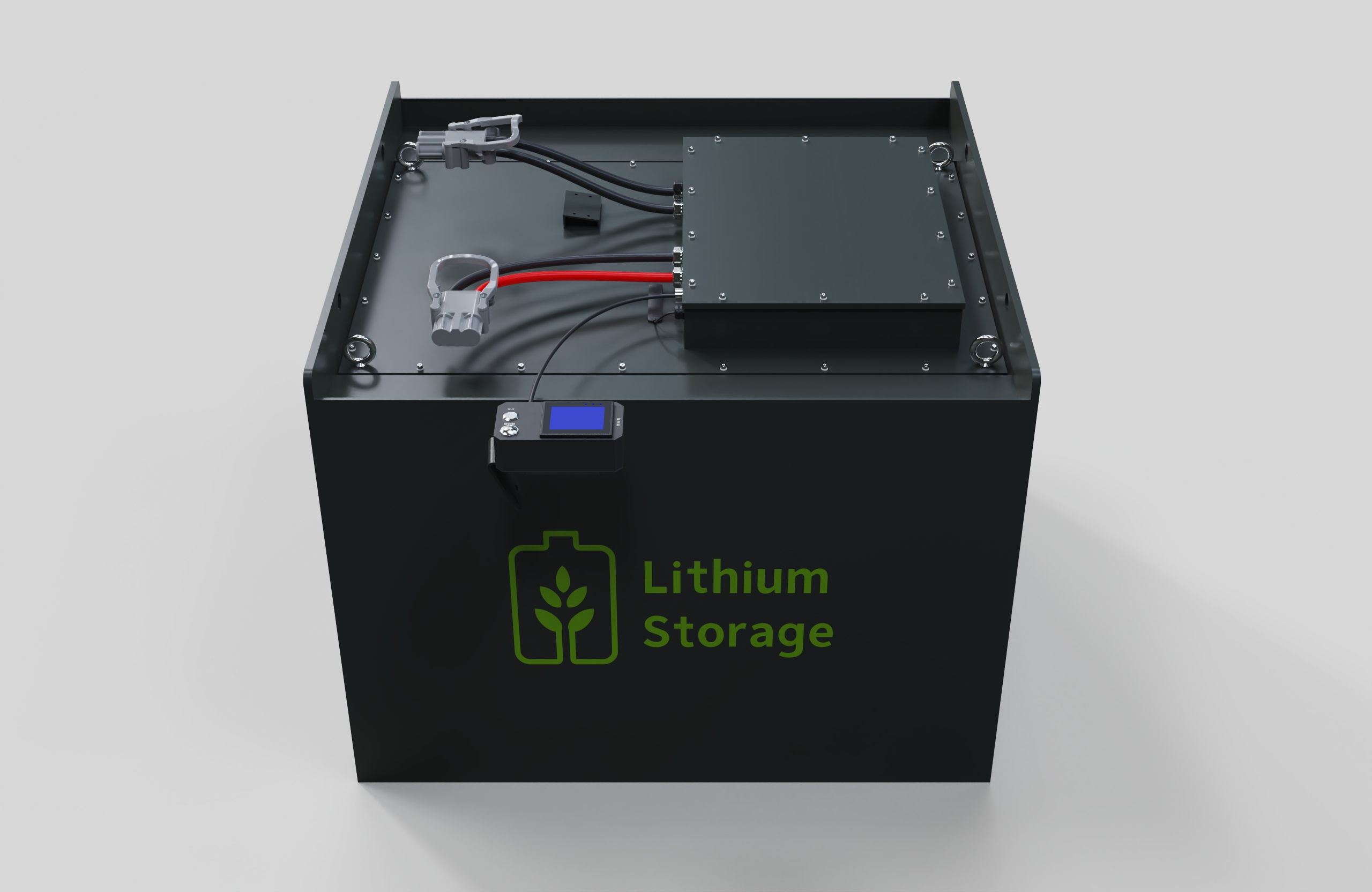
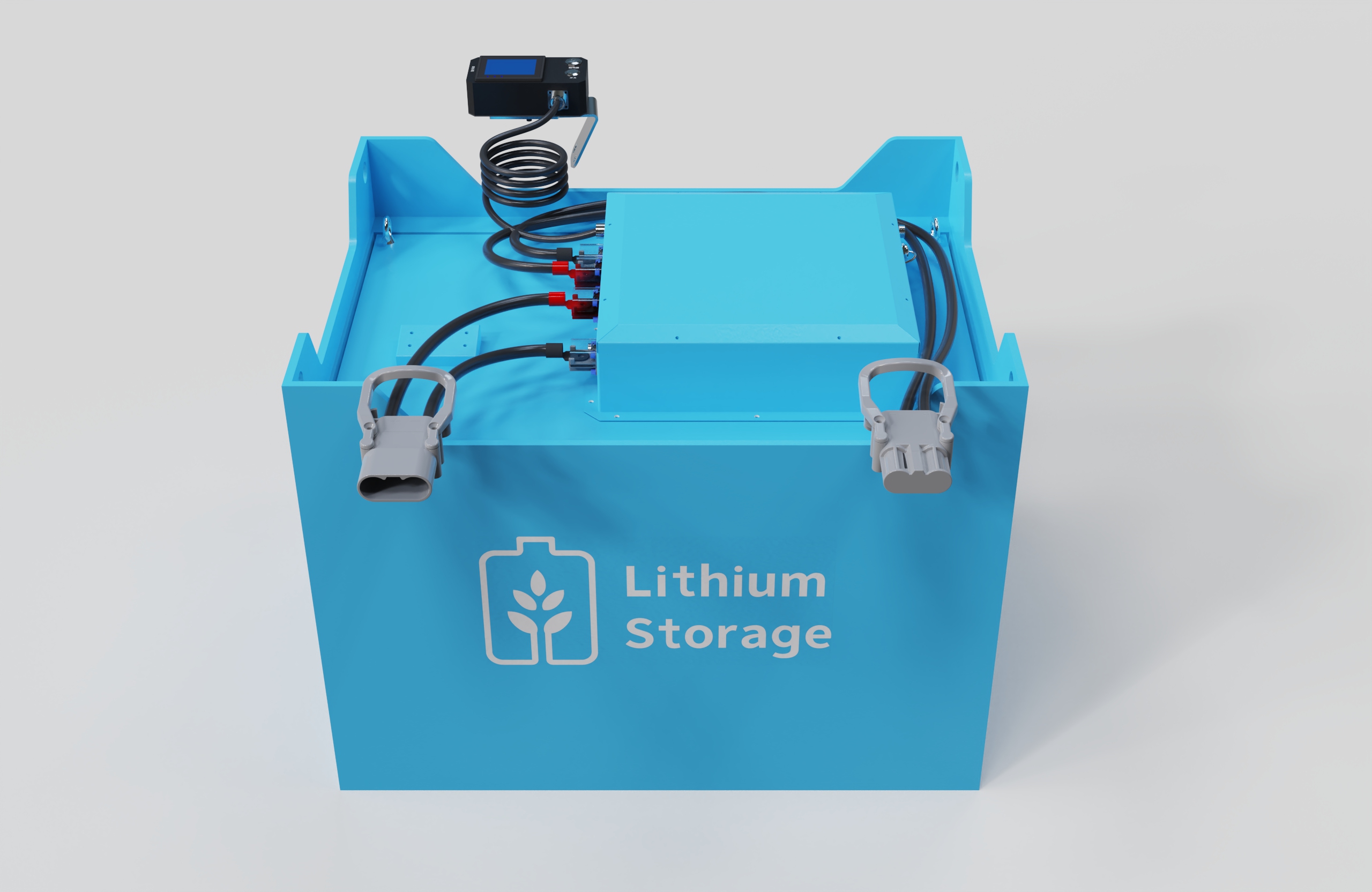
Request a dimensional drawing before approving production. The drawing should identify the outer dimensions, connector position, cable length, lifting points, maintenance access, display location, and charging port.
LITHIUM STORAGE states that its forklift battery systems can be configured with adapted charge and discharge connectors, customized housings, and additional weight for different material handling vehicles.
5. Confirm the Minimum Battery Weight
Weight is particularly important in electric counterbalance forklifts because the traction battery can form part of the truck’s counterweight.
A lithium battery is often lighter than an equivalent lead-acid battery. Installing a lighter pack without compensating for the difference can affect:
Ask the equipment manufacturer or supplier for:
Minimum permitted battery weight
Maximum permitted battery weight
Required center-of-gravity range
Existing battery weight
Approved ballast arrangement
Toyota’s lithium battery systems include features such as built-in counterweight and adjustable spacers to satisfy forklift weight and compartment-fit requirements.
Where additional weight is necessary, it should be securely integrated into the battery enclosure rather than added as an uncontrolled modification.
6. Identify the Battery Chemistry
The term “lithium-ion” covers several battery chemistries. The supplier should state the exact chemistry used in the proposed material handling battery.
LiFePO4, also known as lithium iron phosphate or LFP, is widely used for motive-power applications. Hyster’s 2026 lithium forklift systems use LFP chemistry and cite temperature tolerance, fast charging, long service life, and suitability for multi-shift operation among its characteristics.
Ask for:
Do not evaluate a quotation that states only “lithium battery” without identifying the cells and chemistry.
7. Review the Battery Management System
The battery management system, or BMS, controls and protects the complete pack.
A suitable industrial BMS should monitor:
Individual cell voltage
Pack voltage
Charging and discharging current
Cell and module temperature
State of charge
State of health
Contactor status
Communication faults
Charging and discharging limits
Protection functions should cover:
Buyers should ask not only which protections are listed, but also what the battery does when a limit is reached. For example, the BMS can reduce allowable current, issue an alarm, open the contactor, or prevent charging.
The quotation should also specify whether BMS parameters can be updated, whether fault logs are accessible, and who is authorized to change protection settings.
8. Verify Vehicle Communication
Many modern forklifts and warehouse vehicles require communication between the battery and the equipment controller.
Communication can be used to transmit:
State of charge
Battery voltage
Temperature
Permitted discharge current
Fault status
Low-charge warnings
High-temperature warnings
Charging interlock status
Hyster’s integrated systems communicate battery information to the truck and can display state of charge through the vehicle interface. Its battery and charger also use a defined CAN communication protocol.
Before ordering, confirm:
A battery can have the correct voltage and dimensions but still fail to operate correctly when the communication protocol is incompatible.
9. Match the Charger to the Battery
The charger should be included in the battery-selection process from the beginning.
Confirm:
Charger output voltage
Maximum charging current
AC input voltage
Single- or three-phase supply
Required circuit and breaker capacity
Charger communication protocol
Charging connector
Cable length
Charger installation location
Environmental protection
Charging interlock
Lithium chargers frequently communicate with the BMS so that the battery can control charging current according to temperature, state of charge, and cell conditions. Toyota lists BMS-controlled charging and charger outputs from 120A to 540A for its current lithium battery systems.
Do not assume that the existing lead-acid charger can be reused. Hyster specifically states that its lead-acid and lithium-ion chargers are not interchangeable because their charging profiles and communication requirements differ.
10. Build the Charging Plan Around the Duty Cycle
Lithium material handling batteries are well suited to opportunity charging, but the charging schedule must be calculated rather than assumed.
Opportunity charging uses scheduled idle periods such as:
Meal breaks
Shift changes
Operator rest periods
Loading delays
Production pauses
Cleaning periods
Toyota explains that lithium batteries can remain in the truck across shifts while receiving partial charges during normal operator breaks.
To determine whether this strategy will work, calculate:
Energy used before each charging break
Length of each charging opportunity
Charger output
Maximum permitted battery charging current
Charging efficiency
Required end-of-shift reserve
Number of vehicles sharing each charger
For example, a battery can support fast charging technically but still fail to complete the working day when the charger is undersized or operators do not connect the truck consistently.
Charger positioning also matters. Charging points should be close enough to the work area that operators can connect the equipment without losing significant productive time.
11. Consider Single-Shift and Multi-Shift Requirements
The same forklift model can require different battery capacities depending on utilization.
Light Single-Shift Operation
A smaller-capacity battery can be sufficient where:
The vehicle operates intermittently
Travel routes are short
Loads are moderate
Overnight charging is available
End-of-shift reserve is easy to maintain
Intensive Single-Shift Operation
A larger pack or midday charging can be required where:
The vehicle operates continuously
Lift cycles are frequent
Travel distances are long
Attachments increase hydraulic demand
Downtime is expensive
Multi-Shift Operation
Multi-shift applications require a detailed energy and charging study. Opportunity charging can allow one lithium battery to remain installed across shifts, but only when charging periods restore the energy consumed between breaks.
Hyster’s current high-speed charging systems are intended to support opportunity charging in demanding operations, and their charging interlocks prevent truck movement while the charging cable is connected.
12. Evaluate the Working Environment
Battery specifications should be reviewed against actual environmental conditions.
Cold Storage
Cold warehouses can require:
Insulated battery enclosures
Internal heating
Low-temperature charging protection
Heated charging logic
Condensation management
Cold-resistant cables and seals
Outdoor Operations
Outdoor vehicles can require:
Higher ingress protection
Rain protection
Corrosion-resistant enclosures
Protected charging connections
Wider operating-temperature ranges
Dusty or Wet Environments
Request the complete IP rating and clarify whether it applies to:
Battery enclosure
Connectors
Display
Charging ports
Communication interfaces
An IP rating does not automatically confirm resistance to pressure washing, salt spray, chemicals, or corrosive vapors. These conditions should be stated separately in the purchasing specification.
13. Check Connector and Cable Details
Connector mismatch is a common source of commissioning delays.
The approved specification should include:
Connector manufacturer
Connector series
Current rating
Plug and socket arrangement
Keying
Contact configuration
Cable cross-section
Cable length
Cable exit direction
Charge-port configuration
Discharge-port configuration
Communication contacts
Ask for photographs and drawings rather than relying only on descriptions such as “Anderson connector” or “REMA connector.” Different connector models can look similar while having different current ratings and contact arrangements.
The supplier should also confirm whether charging and discharging use a shared connector or separate ports.
14. Review Safety and Transport Documentation
The required documents depend on the battery model, destination country, transport method, and customer requirements.
Common purchasing documents include:
UN38.3 test summary
Safety Data Sheet
Transport classification documents
IEC or UL test documentation where required
Declaration of conformity
Product inspection report
Serial-number traceability
Packing and labeling information
Emergency response instructions
LITHIUM STORAGE states that its product range has documentation or certification associated with MSDS, UN38.3, UL, IEC 62619, JET, and BIS. Buyers should confirm which documents apply to the exact battery model, configuration, and destination market rather than assuming that every certificate covers every customized pack.
Request document copies before shipment, particularly when the battery will be transported internationally.
15. Compare Cycle Life Under Defined Conditions
Cycle-life claims are difficult to compare unless the test conditions are disclosed.
Ask the supplier to specify:
Depth of discharge
Charging rate
Discharging rate
Test temperature
End-of-life capacity threshold
Whether the result applies to cells or the complete pack
Expected calendar life
Expected energy throughput
A battery tested at a shallow depth of discharge can show a higher cycle count than one tested under deeper discharge conditions. The number alone does not predict service life in a real warehouse.
Battery life is also influenced by:
Cycle life should therefore be considered together with warranty coverage, operating hours, and energy throughput.
16. Read the Warranty Conditions Carefully
A warranty described only as “five years” is incomplete.
Check whether coverage is limited by:
Also confirm:
Who performs diagnosis
Whether remote support is included
Whether modules can be replaced individually
Who pays transportation costs
Whether labor is covered
Availability of onsite service
Spare-parts lead time
Warranty response procedure
A multi-shift fleet can reach an operating-hour limit long before the calendar warranty expires. Compare the warranty against the expected annual use of the equipment.
17. Assess Supplier Engineering and Support
The supplier’s ability to configure and support the battery is as important as the pack itself.
A qualified material handling battery supplier should be able to:
Review the exact vehicle model
Calculate energy requirements
Confirm continuous and peak current
Design the enclosure and ballast
Match connectors and cable positions
Configure CAN communication
Supply a compatible charger
Provide drawings for approval
Complete commissioning
Diagnose vehicle, battery, and charger faults
Supply replacement modules and components
LITHIUM STORAGE presents its forklift battery line as a customized system with charger communication commissioning, connector adaptation, remote and onsite support, and GPS or GPRS functions on selected configurations.
 EN
EN
 fr
fr  de
de  it
it  ru
ru  es
es  pt
pt  tr
tr  jp
jp  ar
ar  th
th 

.jpg "How Long Does a Forklift Battery Last?")
 No.9 East Mozhou Road, Jiangning District, 211111, Nanjing City, China