Upgrading an older Toyota electric forklift from lead-acid to lithium can reduce charging downtime, eliminate routine watering, and make opportunity charging easier for multi-shift warehouse operations. However, choosing a Toyota Forklift Battery replacement is not as simple as matching the voltage shown on the old battery.
Toyota electric equipment spans pallet trucks, stackers, reach trucks, three-wheel forklifts, stand-up riders, and counterbalance trucks. Even two Toyota forklifts operating at the same voltage can require different battery dimensions, minimum weights, connectors, discharge currents, and communication settings.
Toyota currently offers its own lithium-ion solutions in 24V, 36V, and 48V configurations for selected equipment and explicitly notes that only specific battery brands and models are compatible with particular Toyota trucks.
For fleets considering an aftermarket lithium conversion, the best upgrade therefore starts with the exact forklift model and data plate—not with a generic battery catalog.
LITHIUM STORAGE provides customizable LiFePO4 forklift batteries across 24V, 36V, 48V, and 80V platforms and states that its Smart FLT solutions can be configured for Toyota and other forklift brands through enclosure, weight, connector, charger, and vehicle communication adaptation.
Which Lithium Battery Voltage Fits a Toyota Forklift?
The first requirement is non-negotiable:
Keep the battery voltage matched to the forklift's original electrical platform unless Toyota or an authorized engineering process explicitly approves a conversion.
Changing a 36V forklift to 48V, for example, is not a battery upgrade in the normal sense. The controller, traction motor, hydraulic motor, contactors, wiring, display, and charger are designed around a particular voltage range.
A general selection guide looks like this:
| Battery Class | Typical Toyota Equipment to Evaluate | Upgrade Priority |
|---|
| 24V | Pallet trucks, stackers, compact warehouse equipment | Compact size, adequate runtime, easy opportunity charging |
| 36V | Selected stand-up, reach and legacy warehouse trucks | Maintaining compatibility with existing 36V fleets |
| 48V | Three-wheel and four-wheel electric forklifts, stand-up riders and medium-duty trucks | Higher energy capacity and multi-shift operation |
| 80V | Higher-power electric counterbalance platforms where originally specified | Heavy loads and intensive duty; exact compatibility must be confirmed |
Toyota's current battery program covers 24V, 36V, and 48V lithium configurations, while its equipment portfolio also includes higher-voltage electric trucks. A third-party 80V conversion should therefore never be assumed compatible merely because the supplier offers an 80V pack.
1. 24V Lithium Upgrade for Toyota Pallet Trucks and Compact Equipment
For compact warehouse equipment operating on a 24V electrical platform, a LiFePO4 replacement can be one of the most straightforward upgrades.
LITHIUM STORAGE currently lists 24V-class packs including:
25.6V 206Ah
25.6V 228Ah
25.6V 304Ah
25.6V 456Ah
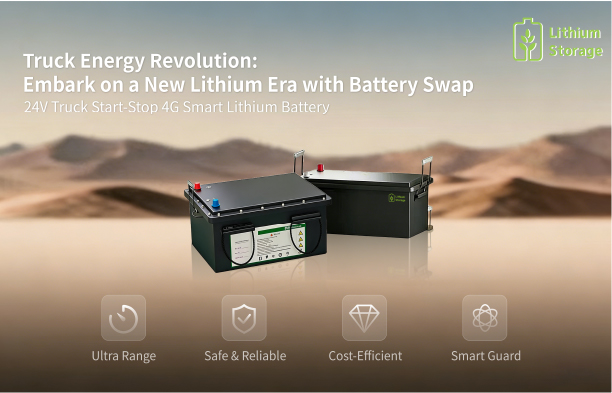
Its 25.6V 304Ah Smart FLT battery is specifically marketed for pallet-truck applications including Toyota used lift trucks. The standard pack provides 304Ah capacity, approximately 7.78kWh nominal energy, IP54 protection, charger CAN communication, customizable discharge connector options, and additional-weight customization.
This type of Toyota Forklift Battery upgrade may suit equipment that requires more runtime than a small pallet-truck battery while remaining on the original 24V platform.
However, the published standard dimensions and weight should still be checked against the exact Toyota truck. A battery advertised for Toyota applications is not necessarily interchangeable across every Toyota 24V model.
When a 24V upgrade makes sense
Consider a higher-capacity 24V lithium solution when:
The forklift data plate specifies 24V.
The existing lead-acid battery no longer completes the required shift.
Operators have regular break-time charging opportunities.
Watering and battery maintenance are creating labor costs.
The battery compartment can accommodate the proposed lithium pack and required ballast.
A larger Ah capacity is not automatically better. The battery should be sized according to actual energy consumption between charging opportunities.
2. 36V Lithium Upgrades for Existing Toyota Warehouse Fleets
36V remains relevant in many North American warehouse fleets, even though newer lithium product lines increasingly emphasize 24V and 48V systems.
Toyota's own lithium-ion offering includes 36V configurations, confirming that this voltage remains part of its current energy-solution architecture.
If an existing Toyota truck is designed for 36V, the safest retrofit approach is normally to retain the same electrical class.
A 36V replacement must still match:
LITHIUM STORAGE also offers a 36V forklift battery platform as part of its Smart FLT range.
For fleets with older but mechanically sound Toyota equipment, replacing an aging lead-acid battery with a correctly engineered lithium solution can extend truck usefulness without redesigning the vehicle's entire electrical architecture.
3. 48V Lithium Upgrades for Electric Counterbalance Forklifts
48V is particularly important for medium-duty electric forklifts.
Toyota currently uses lithium-ion options across several electric forklift categories, including its 3-Wheel Electric Forklift, Core Electric Forklift, and Stand-Up Rider Forklift. Its current lithium battery solutions are available in configurations up to 48V.
LITHIUM STORAGE's 48V-class LiFePO4 range includes capacities from approximately:
51.2V 206Ah
51.2V 228Ah
51.2V 314Ah
51.2V 412Ah
51.2V 456Ah
51.2V 560Ah
51.2V 628Ah
This broad range makes 48V particularly flexible for lead-acid replacement projects because the battery can be selected according to required kWh rather than simply copying the previous lead-acid Ah rating.
A 48V 206Ah lithium battery and a 48V 628Ah battery clearly target very different operating profiles.
For a single-shift truck with frequent charging breaks, a smaller pack may be sufficient. For two-shift or high-throughput warehouse operation, additional capacity may reduce dependence on charging and provide a larger SOC reserve.
4. Do Not Choose a Toyota Forklift Battery by Ah Alone
One of the most common retrofit mistakes is comparing only the Ah figure on the existing lead-acid battery.
Battery energy is better understood in kWh:
Nominal energy = nominal voltage × Ah ÷ 1,000
For example:
A 51.2V 456Ah lithium pack contains approximately:
51.2 × 456 ÷ 1,000 = 23.35kWh
But even kWh is not enough by itself.
Two Toyota forklifts can consume very different amounts of energy depending on:
Load weight
Travel distance
Lift height
Number of lifts per hour
Ramp operation
Hydraulic attachments
Floor conditions
Cold-storage operation
Operator behavior
Shift duration
The best battery upgrade should therefore be based on measured or estimated energy consumption per shift and the time available for opportunity charging. LITHIUM STORAGE similarly recommends evaluating usable energy, peak current, operating hours, and charging intervals rather than selecting by voltage and Ah alone.
5. Battery Weight Is Critical on Counterbalance Toyota Forklifts
Lithium batteries are generally lighter than equivalent lead-acid batteries.
In a passenger EV, lower weight is usually an advantage.
In a counterbalance forklift, it can be a problem.
The battery may form part of the truck's counterweight system. Installing an excessively light replacement can change vehicle balance and may affect lifting capacity or safe operation.
Toyota's own 5/35 lithium batteries address this issue with built-in counterweights and adjustable spacer tabs designed to satisfy truck weight and compartment requirements.
An aftermarket Toyota Forklift Battery should be approached the same way.
Before ordering, provide:
Existing battery weight
Minimum permitted battery weight
Maximum permitted battery weight
Battery compartment length
Width
Height
LITHIUM STORAGE's Smart FLT platform supports additional-weight customization and enclosure adaptation for different forklift brands and models.
The replacement should therefore be engineered to fit both the electrical and mechanical requirements of the truck.
6. Confirm Connector and Cable Arrangement
A battery can have the correct voltage, capacity, size, and weight and still be unusable if its power connection does not match the truck.
Confirm:
This is especially important on existing fleets because previous owners or service companies may have modified connectors.
Sending clear photographs helps, but dimensions and connector identification are more reliable.
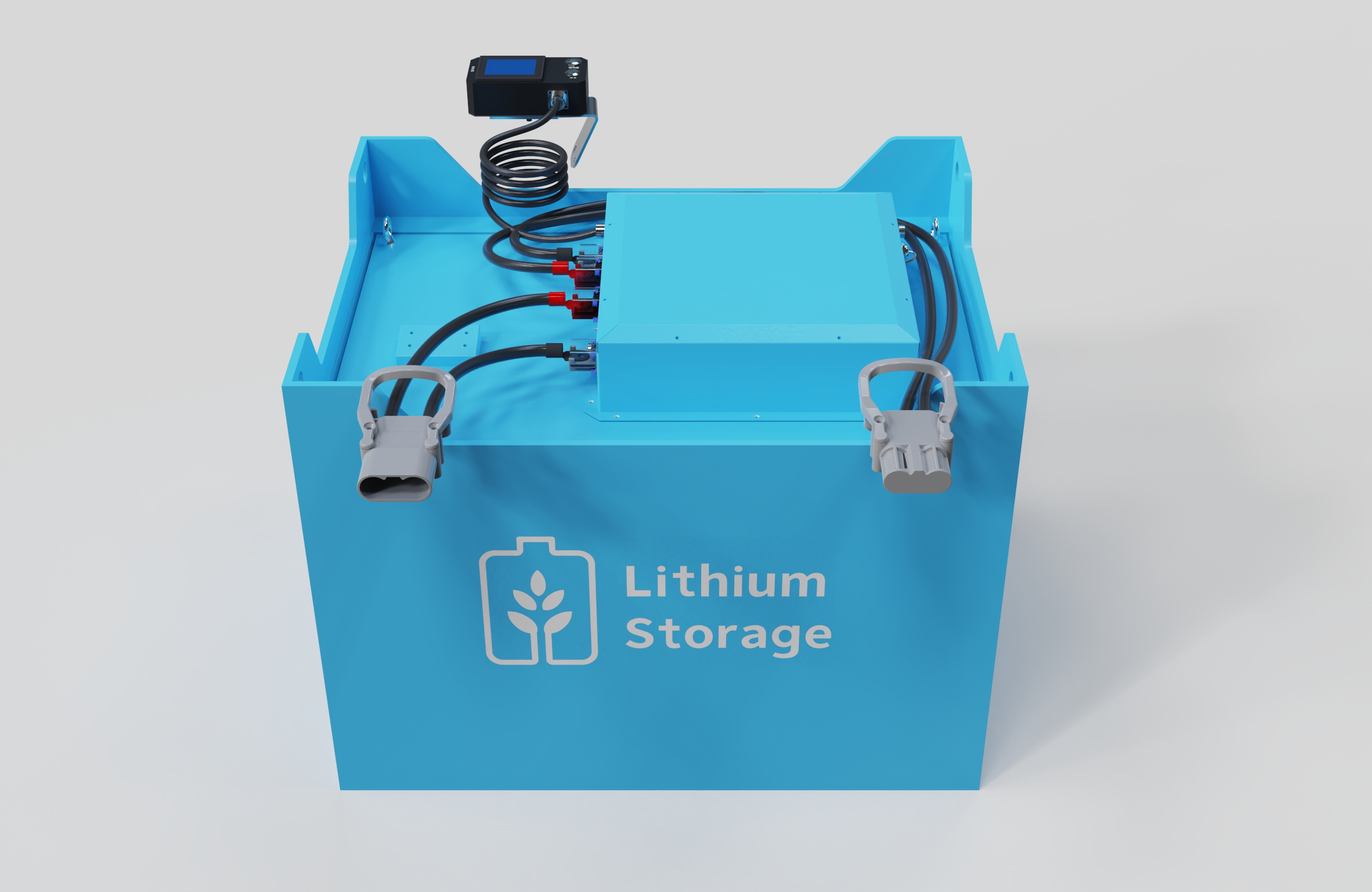
LITHIUM STORAGE's forklift battery platform supports charge/discharge connector adaptation as part of its customization process.
7. CAN Communication Can Determine Whether the Upgrade Works Properly
Modern electric forklifts increasingly exchange information with the battery.
Depending on the Toyota model, communication may involve information such as:
State of charge
Battery temperature
Fault status
Charge permission
Current limits
Drive-away protection
Toyota's current lithium solutions use BMS communication with both the forklift and compatible charger on applicable configurations.
An aftermarket retrofit may therefore require more than connecting positive and negative cables.
The battery supplier should confirm whether the exact truck requires CAN communication and whether the necessary protocol has been validated.
LITHIUM STORAGE lists vehicle CAN communication support and charger communication commissioning among the Smart FLT platform capabilities.
8. Replace the Charger as Part of the Lithium Upgrade
The existing lead-acid charger should not automatically be retained.
Lithium batteries require a suitable charging profile and, in many systems, BMS-to-charger communication.
Toyota's current lithium chargers are designed specifically to communicate with its lithium battery BMS and are available in multiple voltage and current configurations.
Similarly, LITHIUM STORAGE supplies dedicated:
24V lithium battery chargers
48V lithium battery chargers
80V lithium battery chargers
Higher-voltage and dual-connector chargers
For a retrofit project, specify the battery and charger together whenever possible.
The charger should be selected based on:
battery Ah + allowable charging current + available break time + AC power supply
rather than simply selecting the highest available amperage.
9. Choose Capacity Around Shift Pattern
One of the strongest reasons for upgrading to lithium is the ability to charge during natural downtime.
For example:
Single-Shift Operation
A moderate-capacity battery may be sufficient when the forklift returns to a charger overnight and only performs normal warehouse work.
Two-Shift Operation
More battery energy or higher-powered opportunity charging may be required to maintain enough SOC through the second shift.
LITHIUM STORAGE recommends approximately 410–560Ah in its 48V range for many double-shift scenarios, although actual requirements depend on truck energy consumption and charging opportunities.
Three-Shift / Continuous Operation
A high-capacity pack and carefully designed opportunity-charging schedule become more important.
The supplier should determine:
starting energy + energy restored during breaks ≥ total operating consumption + reserve
This is more reliable than simply choosing the largest available battery.
10. Cold-Storage Toyota Forklifts Need Additional Battery Features
Food, pharmaceutical, and frozen-storage warehouses place special demands on batteries.
Toyota's latest 5/35 lithium platform incorporates thermal management for hot and cold applications and is designed for environments such as cold storage and food-and-beverage operations.
For an aftermarket lithium replacement, buyers should similarly specify:
Minimum warehouse temperature
Charging-area temperature
Time continuously spent in cold storage
Whether the truck charges inside the freezer
Heating requirements
Enclosure IP requirement
LITHIUM STORAGE can incorporate heating and environmental adaptations into customized forklift batteries.
A standard warehouse battery should not automatically be assumed suitable for freezer operation.
What Information Is Needed to Match a Toyota Forklift Battery?
Before requesting a lithium replacement quotation, provide the supplier with:
Toyota forklift model
Serial number
Forklift data-plate photo
Existing battery label
Rated voltage
Existing Ah capacity
Existing battery dimensions
Existing battery weight
Minimum required battery weight
Connector information
Continuous and peak operating current, if available
Daily operating hours
Number of shifts
Available charging breaks
Existing charger information
Working temperature
Any CAN communication requirements
Toyota itself recommends using the model and serial information on the truck data plate when identifying replacement components and technical requirements.
Providing this information prevents a lithium upgrade from becoming a trial-and-error replacement.
Which Lithium Upgrade Is Best for Your Toyota Forklift?
There is no single best Toyota Forklift Battery for every model.
A useful starting point is:
24V Toyota warehouse equipment:
Consider a compact 25.6V LiFePO4 pack, with capacities selected according to runtime and available charging windows. LITHIUM STORAGE specifically lists a 25.6V 304Ah battery for applications including Toyota used lift trucks.
36V Toyota forklifts:
Retain the 36V electrical platform and match the new lithium battery to the existing compartment, weight, current and communication requirements.
48V Toyota electric forklifts:
A broader selection of lithium capacities can support anything from single-shift warehouse work to intensive multi-shift operation, provided the pack dimensions, weight, connectors, current capability and CAN interface are correctly matched.
Higher-voltage Toyota equipment:
Do not assume an 80V aftermarket battery is compatible because Toyota manufactures 80V electric forklifts. Verify the exact truck specification and obtain engineering confirmation before conversion.
LITHIUM STORAGE states that its Smart FLT battery platform can be customized for Toyota forklifts and other major material-handling brands, with 24V, 36V, 48V and 80V LiFePO4 configurations, customized enclosures, ballast, connectors, charger communication and vehicle CAN support.
The best upgrade is therefore not the battery with the largest Ah rating. It is the one that correctly matches the Toyota truck's voltage, usable energy requirement, peak current, compartment dimensions, required counterweight, connector, communication protocol, charger and operating environment.
For fleet owners replacing aging lead-acid batteries, working through these parameters before ordering can turn a lithium conversion into a practical productivity upgrade rather than a compatibility problem.
 EN
EN
 fr
fr  de
de  it
it  ru
ru  es
es  pt
pt  tr
tr  jp
jp  ar
ar  th
th 



 No.9 East Mozhou Road, Jiangning District, 211111, Nanjing City, China